Rogers PCB
LEADHUI PCB provides custom Rogers PCB manufacturing for RF, microwave, high-speed digital, communication, automotive radar, aerospace, and other electronic applications that require stable dielectric performance, low signal loss, and reliable high-frequency transmission.Get A Quote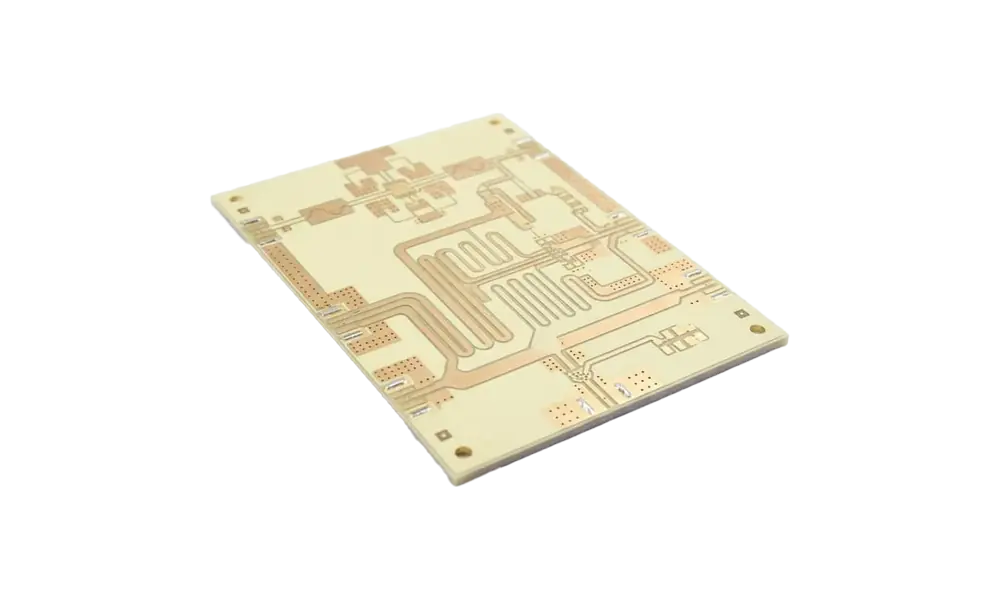
Rogers PCB Types We Support

Single-Sided Rogers PCB
Single-sided Rogers boards are suitable for simpler RF and microwave structures where controlled electrical performance is needed.
Double-Sided Rogers PCB
Double-sided Rogers boards support more complex routing and are commonly used in wireless communication and RF module applications.
Hybrid Rogers PCB
Hybrid Rogers PCBs combine Rogers materials with FR4 in the same stackup to balance electrical performance and cost. These are often used when only selected layers require high-frequency laminate.
Controlled Impedance Rogers PCB
Controlled-impedance Rogers boards are designed for circuits that require accurate and repeatable impedance performance for RF or high-speed signals.
What Is a Rogers PCB?
A Rogers PCB is a printed circuit board manufactured using Rogers high-frequency laminate materials instead of standard FR4. These materials are designed for applications where electrical performance at high frequencies is especially important.
Rogers PCB materials are commonly used because they provide:
- Low dielectric loss
- Stable dielectric constant
- Better impedance consistency
- Improved signal integrity
- Good thermal stability
- Reliable performance in RF and microwave circuits
Rogers boards are often used in products where standard FR4 cannot provide the required electrical performance.
Why Choose Rogers PCB?
More Stable Dielectric Properties
Rogers materials are designed for RF and microwave circuits that require lower signal loss and stable transmission performance.
More Stable Dielectric Properties
A more consistent dielectric constant helps improve impedance control and signal predictability.
Better Thermal Stability
Rogers laminates provide more stable performance across varying temperature conditions compared with many standard PCB materials.
Lower Insertion Loss
Rogers PCB materials help reduce signal attenuation in high-frequency applications.
Rogers PCB Capabilities
From rapid prototyping to high-volume mass production, LEADHUI supports a wide range of custom specifications to match your exact project needs:
| Capability Item | Specification |
|---|---|
| Rogers PCB Type | Single-Sided Rogers PCB, Double-Sided Rogers PCB, Multilayer Rogers PCB, Hybrid Rogers PCB, Controlled Impedance Rogers PCB |
| Material Options | Rogers high-frequency laminates and hybrid material stackups according to project requirements |
| Layer Count | Single-sided, double-sided, and multilayer Rogers PCB structures available upon engineering review |
| Board Structure | Pure Rogers stackups and Rogers + FR4 hybrid stackups available depending on design requirements |
| Copper Thickness | Standard and custom copper thickness options available according to signal, current, and thermal requirements |
| Surface Finish | ENIG, HASL, Lead-Free HASL, OSP and other finishes upon review |
| Impedance Control | Controlled impedance support available according to stackup and fabrication requirements |
| Profile Processing | CNC Routing, slots, cutouts, custom board outline, panelized production |
| Testing | Electrical Test, Impedance-related review, Final Quality Inspection |
| Applications | RF, Microwave, Radar, Communication, High-Speed Digital, Aerospace, Automotive, Medical Electronics |
Aluminum PCB FAQ
What is the main advantage of aluminum PCB?
The main advantage is heat dissipation. Aluminum PCBs help transfer heat away from LEDs, power components, and high-current circuits.
Is aluminum PCB better than FR4 PCB?
It depends on the application. FR4 is suitable for general electronic circuits, while aluminum PCB is better for products that require improved thermal management.
Can aluminum PCB be used for LED lighting?
Yes. Aluminum PCB is widely used in LED modules, LED strips, downlights, panel lights, street lights, and other lighting products.
Can LEADHUI PCB provide aluminum PCB assembly?
Yes. LEADHUI PCB can support aluminum PCB fabrication and assembly, including component sourcing, SMT assembly, inspection, and testing.
Start Your Rogers PCB Project
Request A QuoteHelp Center