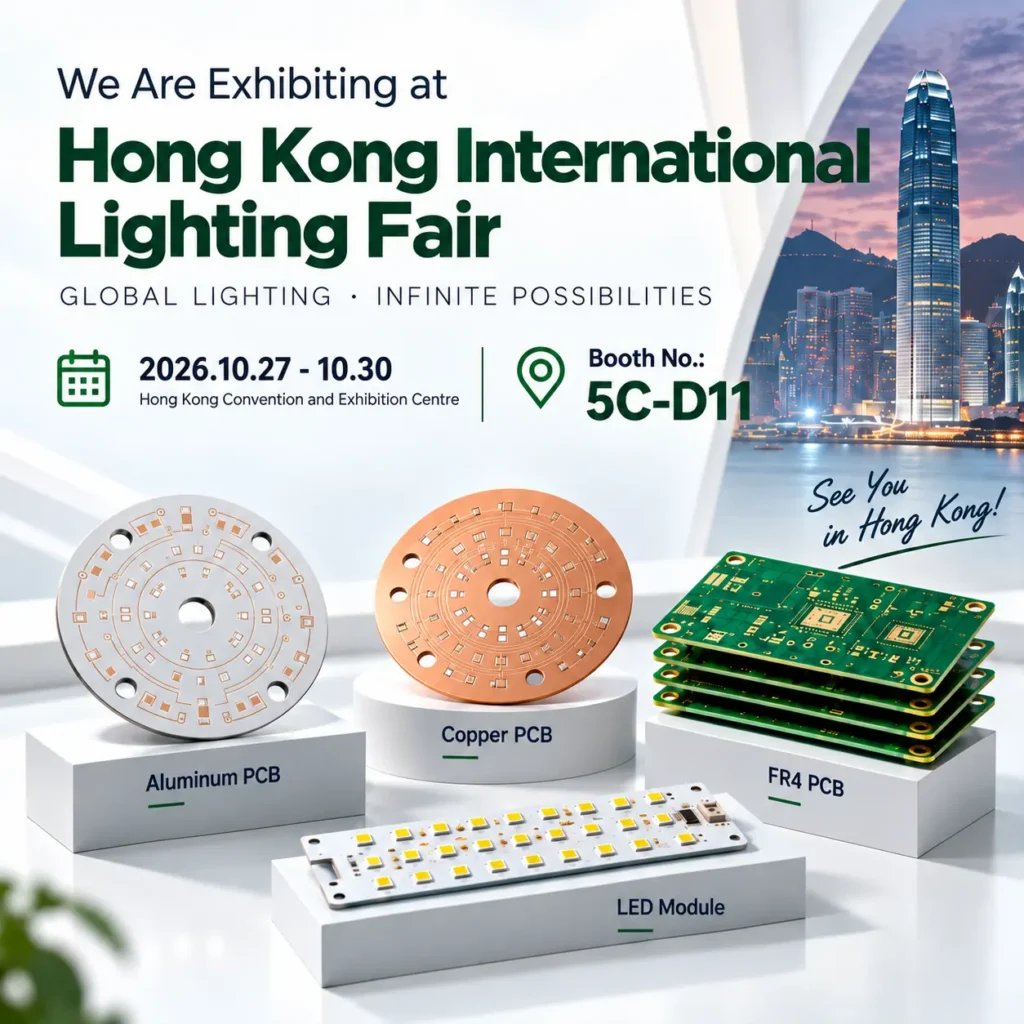
Aluminum PCB
Manufacturer
Send us your design files and target specifications. Our engineers will review the board structure and manufacturing requirements before quoting.
ISO & IPC Certified
Single-sided, multilayer, DTP options.
Prototypes through mass production.
lengths up to 1800mm.
Technical Capabilities
Manufacturing options for standard LED boards, multilayer circuits and demanding thermal applications. Materials, stackup and special processes are confirmed during engineering review.
| Parameter | Capability |
|---|---|
| Board Structures | Single-sided, double-sided, multilayer, hybrid and DTP |
| Circuit Layers | 1, 2, 4 and 6 layers, depending on construction |
| Aluminum Materials | 1060, 5052 and 6061, depending on material availability |
| Standard Dielectric Conductivity | 1.0, 1.5, 2.0 and 3.0 W/m·K |
| Finished Board Thickness | 0.5–3.6 mm; special thicknesses by review |
| Finished Copper | 1–4 oz; heavier copper by review |
| Minimum Trace / Space | 4 / 4 mil — approximately 0.10 / 0.10 mm |
| Minimum Hole Size | 0.8 mm for single-layer; 0.2 mm for two-layer constructions |
| Long Board Length | Up to 1800 mm, depending on construction and profile |
| Via Processing | Insulated PTH, tented vias, plugged vias and exposed vias |
| Surface Finishes | Lead-free HASL, ENIG, OSP, immersion silver, hard gold and ENEPIG |
| Solder Mask | White, black, green, red, blue, yellow, purple and matte options |
| Silkscreen | White and black |
| Profile Processing | CNC routing, V-cut, slots, cutouts and mounting holes |
| Inspection & Testing | Flying probe, electrical testing, AOI and final inspection |
| Assembly Support | SMT, through-hole and mixed assembly |
Types of Aluminum PCBs
Choose an aluminum PCB structure based on your routing needs, component layout and thermal requirements.
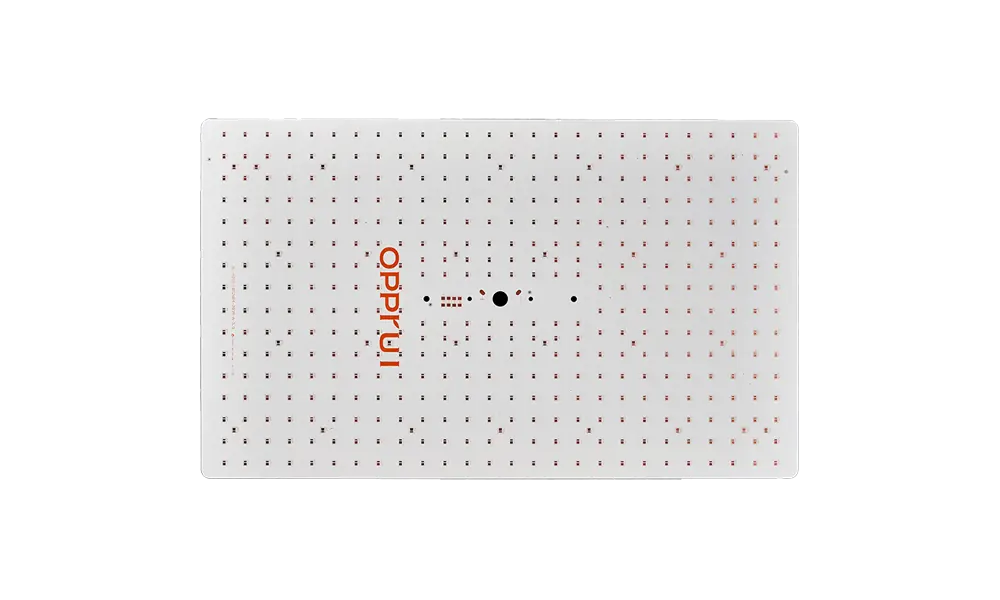
Single-Sided Aluminum PCB
A copper circuit layer sits above a thermally conductive dielectric and aluminum base. This structure spreads heat from components while keeping the circuit layout straightforward.
Key features:
- One circuit layer;
- flexible board shapes and solder mask options;
- suitable for prototypes and production.
Applications: LED modules, linear lighting, illuminated signs and simple power boards.
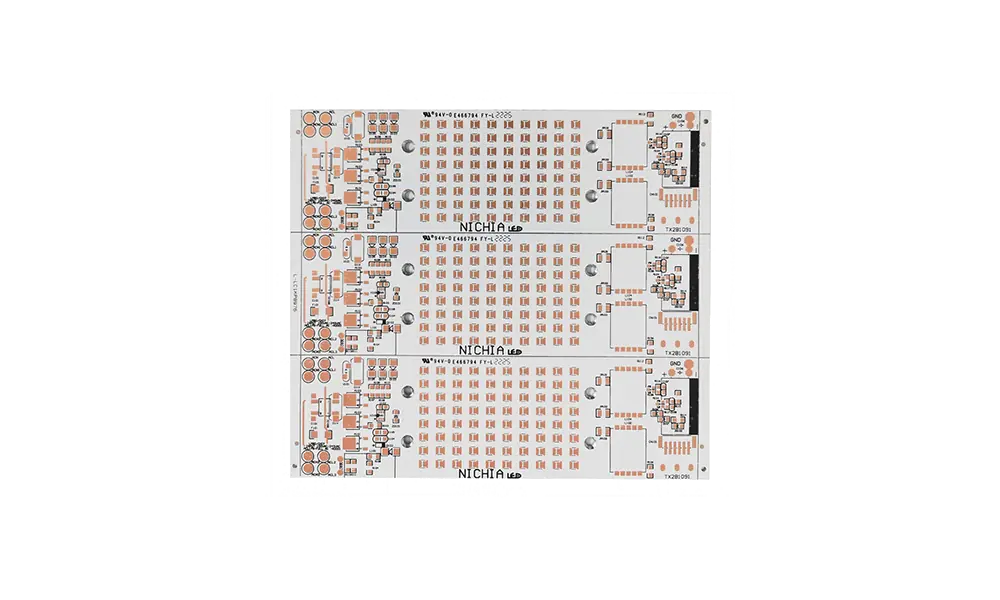
Double-Sided & Multilayer
Additional circuit layers provide more routing space for designs with denser components or more complex connections. Insulated vias and separation from the aluminum base are reviewed for each stackup.
Key features:
-
Direct heat transfer beneath selected thermal pads.
-
Structure matched to the component footprint.
-
Electrical isolation reviewed for each design.
Applications: LED drivers, automotive lighting controllers, industrial control modules and power conversion boards.

Direct Thermal Path (DTP)
DTP designs create a direct heat-transfer path beneath selected component thermal pads. Suitability depends on the component footprint, electrical isolation requirements and board construction.
Key features:
- Direct heat transfer beneath selected thermal pads.
- Structure matched to the component footprint.
- Electrical isolation reviewed for each design.
Applications: High-power LED modules, compact lighting engines and power devices with concentrated heat sources.

Why Choose LEADHUI for Aluminum PCBs?
Long-Strip Capability
Aluminum PCB lengths up to 1800 mm for lighting designs. Width, thickness and dimensional requirements are reviewed for each project.
Structure Selection
Single-sided, multilayer and DTP options to match your routing, thermal and electrical requirements.
Engineering Review
Board construction, materials, holes and manufacturing requirements are reviewed before quoting.
Prototype to Production
Support for prototype builds and production orders, with specifications confirmed for each design.
What Is an Aluminum PCB?
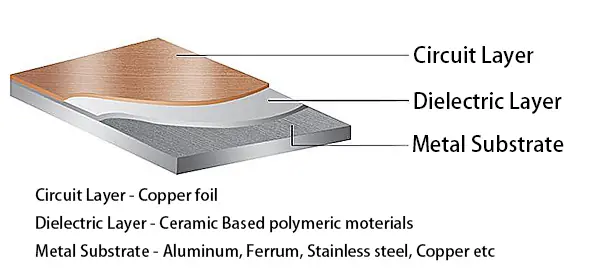
An aluminum PCB is a type of metal core printed circuit board. Instead of a conventional FR-4 base, it uses an aluminum base plate beneath an electrically insulating dielectric layer and copper circuitry.
This structure helps move heat away from heat-generating components and distribute it across the aluminum base. Compared with standard FR-4 boards, aluminum PCBs can provide stronger thermal performance for applications where LEDs, power devices, and other components create concentrated heat.
A typical aluminum PCB construction includes:
- Copper circuit layer
- Thermally conductive dielectric layer
- Aluminum base layer
Aluminum PCB Manufacturing Process
1. Design and Engineering Review
We review Gerber files, board outline, copper thickness, surface finish, thermal requirements, assembly requirements, and special mechanical features before production.
2. Material Preparation
The aluminum base material, dielectric layer, and copper foil are prepared according to the approved board construction.
3. Circuit Imaging and Etching
Copper foil is imaged and etched to form the required pads, traces, thermal areas, and electrical connections.
4. Drilling and Board Profiling
Mounting holes, vias where applicable, slots, cutouts, and custom board outlines are produced according to the approved fabrication files.
5. Solder Mask, Silkscreen, and Surface Finish
Solder mask is applied to protect the copper circuitry. Silkscreen markings and the requested surface finish are added to support reliable assembly.
6. Inspection and Testing
Finished boards receive visual inspection and applicable electrical checks before packing. Functional testing can be arranged for assembled products according to customer requirements.
Why Choose Aluminum PCB?
Better Heat Dissipation
The aluminum base helps transfer heat away from LEDs, MOSFETs, power ICs, and other heat-generating components. This can support improved product stability and longer operating life when thermal design is properly managed.
Reduced Need for External Heat Sinks
For some lighting and power applications, an aluminum PCB can act as part of the thermal-management structure, reducing the need for separate heat-sink components or simplifying mechanical assembly.
Strong Mechanical Support
Aluminum-core boards provide good rigidity and dimensional stability, making them suitable for lighting modules, long boards, high-power devices, and products exposed to vibration or repeated handling.
Suitable for Cost-Conscious Thermal Designs
Aluminum PCBs are commonly used where better thermal performance is needed but ceramic or more specialized materials would be unnecessarily expensive.
Aluminum PCB FAQ
What is the difference between an aluminum PCB and an FR-4 PCB?
An aluminum PCB uses a metal base and thermally conductive dielectric layer to improve heat transfer. FR-4 is a glass-reinforced epoxy material used for standard rigid PCBs. Aluminum PCB is often preferred for LED and power applications with higher heat-generation requirements.
Are aluminum PCBs only used for LED lighting?
No. Although they are common in LED lighting, aluminum PCBs are also used in power supplies, chargers, motor controllers, automotive lighting, power modules, and other electronics requiring thermal management.
Can you assemble components on aluminum PCBs?
Yes. LEADHUI PCB supports aluminum PCB assembly, including SMT, through-hole components, LED modules, connectors, wire assembly, and functional testing based on project requirements.
Can aluminum PCBs be customized in long-strip shapes?
Yes. Aluminum PCB strips and bars can be manufactured in custom lengths and widths with mounting holes, cutouts, connectors, scoring, and panelization according to your design.
Can you provide white solder mask for LED PCBs?
Yes. White solder mask is commonly requested for LED lighting boards because it can improve light reflectivity. Other solder mask colors are also available based on project requirements.