For a straightforward PCB prototype or a small assembly order that fits JLCPCB’s Economic PCBA rules, start with JLCPCB, especially when the components are already in its inventory. For rigid-flex or extensive custom fabrication requirements, shortlist PCBWay early. These recommendations follow from JLCPCB’s economical assembly tier and PCBWay’s documented advanced manufacturing options.
The JLCPCB vs PCBWay decision changes depending on whether you need a bare PCB or a PCBA—a board with components assembled. A low fabrication price says little about the component bill, assembly charges, or delivery cost.
Both suppliers offer external component sourcing and customer-supplied parts. JLCPCB also announced HDI manufacturing in September 2026, so neither outsourced sourcing nor HDI is an exclusive PCBWay advantage.
Key Takeaways
- JLCPCB for standard prototypes and automated PCBA: Best for basic FR-4 boards and single-sided Economic PCBA ($8.18 setup) with in-stock parts.
- PCBWay for complex builds and custom sourcing: Best for rigid-flex, heavy copper (up to 8 oz), consigned parts, and box-build assembly.
- HDI is now offered by both: JLCPCB introduced HDI in September 2026, ending PCBWay’s exclusivity in microvia manufacturing.
- Promo rates exclude real landed costs: The $2 or $5 entry offers exclude stencils, component sourcing, SMT labor, and freight.
- Component readiness dictates turnaround: Advertised 24-hour builds cover bare boards only; global parts sourcing (9–15 days) defines the true deadline.
JLCPCB vs PCBWay at a Glance
Research date: September, 2026. All prices are USD. These are supplier-published offers and specifications, not matched quotations or independent quality measurements.
| Comparison Area | JLCPCB | PCBWay | Practical Sourcing Implication |
|---|---|---|---|
| Best Suited For | High-speed automated prototyping, standard FR-4 builds, budget-sensitive Economic PCBA | Advanced & specialty processes, rigid-flex, heavy copper, sales/engineering-assisted orders | Choose JLCPCB for standardized efficiency; choose PCBWay for complex builds requiring manual engineering review. |
| Advertised Entry PCB Price | From $2 for 5 boards (Restricted to JLCONE Desktop app; ~$4 on Web) | From $5 for 10 boards (Standard 2-layer, 100 × 100 mm promotional configuration) | Promo prices cover bare fabrication only; compare door-to-door landed cost including shipping and tariffs. |
| Layer Count Range | 1–32 layers (Standard FR-4 catalog) | 1–14 layers (Standard quick-turn); Up to 64 layers (Advanced full-feature service) | Beyond 14–16 layers, both suppliers require detailed engineering review and custom stackup confirmation. |
| Standard Min. Trace / Space | 4/4 mil (1–2 layers, 1 oz); 3.5/3.5 mil (Multilayers) | 4/4 mil (Standard service); Down to 2/2 mil under specific advanced/local conditions | Manufacturing limits, not recommended routing targets; tighter tolerances increase cost and lead time. |
| Min. Mechanical Hole Size | 0.15 mm (Finished hole size depends on plating) | 0.15 mm | Microvias require specific HDI review rather than standard mechanical drill rules. |
| Controlled Impedance | Available (Standard tolerance ±10%) | Available (Standard tolerance ±10%; tighter on custom quote) | Must specify dielectric constants (Dk), exact prepreg/core stackup, and test coupon requirements. |
| Specialty & Advanced PCB | FR-4, Flex, Metal-Core, High-Frequency (Rogers/PTFE); HDI launched Sept 2026 | Flex, Rigid-Flex, HDI (Any-layer), Rogers, Metal-Core, Heavy Copper (up to 8 oz), Ceramic | PCBWay remains the established shortlist for rigid-flex and thick copper; confirm JLCPCB’s specific HDI buildup rules. |
| Surface Finishes | HASL, Lead-free HASL, ENIG, selected OSP | HASL, Lead-free HASL, ENIG, Hard Gold, ENEPIG, Immersion Silver, Immersion Tin, OSP | PCBWay offers a wider catalog of standard finishes for industrial, RF, or edge-connector applications. |
| Assembly Starting Fee (PCBA) | Economic PCBA: Setup from $8.18 + $1.53 stencil + $0.0016/joint Standard PCBA: Setup from $25.56 single-sided / $51.12 double-sided | Advertised from $29 for 20 pcs (SMT labor/setup starting promo; PCB and parts excluded) | JLCPCB Economic is unbeatable for simple single-sided boards (2–50 pcs); PCBWay scales more flexibly for hybrid/complex assemblies. |
| Component Sourcing | In-stock library (730k+ parts), pre-order private library, global sourcing, consignment | Full turnkey, partial turnkey (combo), and fully customer-supplied / kitted parts | Match critical ICs against JLCPCB’s library first; PCBWay is practical when you already own rare parts or need custom kitting. |
| Fastest Bare-Board Lead Time | As fast as 24 hours (Eligible 1/2-layer prototypes) | As fast as 24 hours (Eligible 1/2-layer prototypes) | Advertised hours represent factory production time; international shipping and customs typically add 3–7 business days. |
| Mechanical & Value-Added Services | CNC machining, 3D printing, sheet metal, SMD stencils | CNC machining, 3D printing, sheet metal, injection molding, box-build, cable assembly | PCBWay offers a broader suite of end-to-end electromechanical and final enclosure assembly services. |
The layer ranges and service features are separate from promotional eligibility. Neither starting PCB price is a delivered-order total.
What Do the Advertised Prices Actually Include?
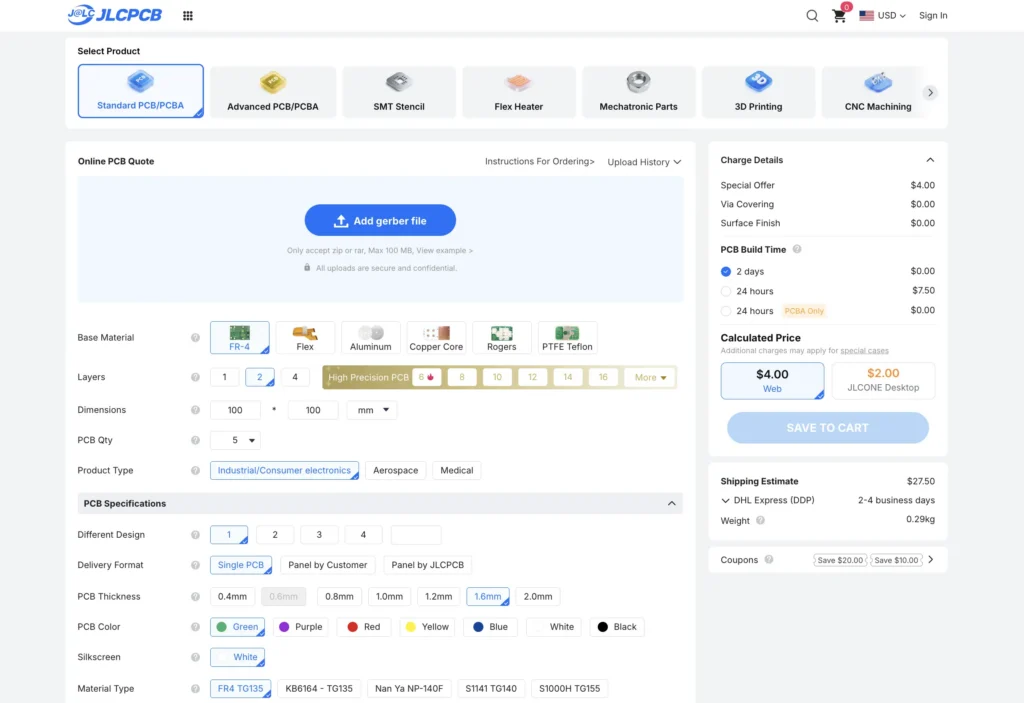
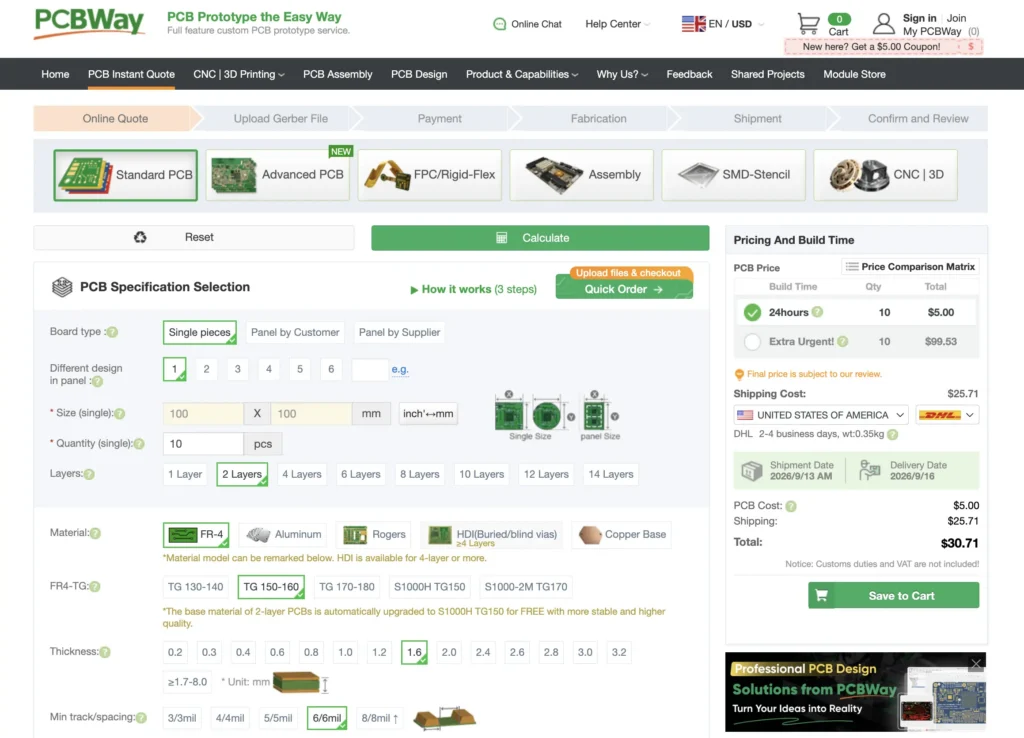
Bare boards: $2 for five versus $5 for ten
JLCPCB advertises the lower starting batch price, while PCBWay’s offer includes a different quantity. That makes the two offers useful entry points, but insufficient evidence for a savings calculation.
JLCPCB’s August 22, 2026 announcement says its $2 deal is available only through JLCONE Desktop. The consulted announcement does not fully enumerate qualifying board dimensions, finishes, or copper weights. PCBWay’s promotion links to ten two-layer boards at 100 × 100 mm, but the linked configuration does not establish every eligible finish and thickness. Treat these as conditional promotions rather than prices for arbitrary designs.
For a useful comparison, use the quantity you actually need. If your project requires ten boards, comparing a five-board promotion with a ten-board promotion answers the wrong purchasing question.
PCBA: setup fees, parts, assembly, and delivery
An assembly setup fee pays for preparing the job. It does not buy a complete batch of populated boards.
JLCPCB’s detailed price schedule, updated September 9, 2026, lists:
| Charge | Economic PCBA | Standard PCBA |
|---|---|---|
| Setup | $8.18 | $25.56 single-sided; $51.12 double-sided |
| Stencil | $1.53 | $8.21 single-sided; $16.42 double-sided |
| SMT assembly | $0.0016 per solder joint for 1–100,000 joints | $0.0016 per solder joint for 1–50,000 joints |
Components, feeder loading, manual work, fixtures, inspection, and other applicable charges can add to these figures. According to JLCPCB’s assembly price schedule published fees may fluctuate with exchange rates.
For a hypothetical ten-board Economic order, setup plus stencil would total $9.71, or approximately $0.97 per assembled board for those two charges alone. This illustrates how fixed fees spread across a batch; it is not a complete assembly quotation.
PCBWay’s $29-for-20-pieces promotion is an assembly starting offer. Its quotation page explicitly excludes PCB fabrication and component costs, with the final quotation subject to file review. The promotion’s complete design eligibility was not specified in the consulted material.
Hypothetical comparison: Suppose you need ten 80 × 60 mm, two-layer FR-4 boards, 1.6 mm thick, with 1 oz copper, green solder mask, and lead-free HASL finish. Enter that same specification at both suppliers. For an assembled version, use the identical bill of materials (BOM), manufacturer part numbers, placement file, populated sides, and testing requirements.
Compare the resulting board, component, assembly, and delivery charges separately. This reveals whether a difference comes from fabrication, a particular component, or the assembly process. No quoted total is assumed for this example.
Which Capabilities Change the Choice?
Standard FR-4 prototypes and multilayer boards
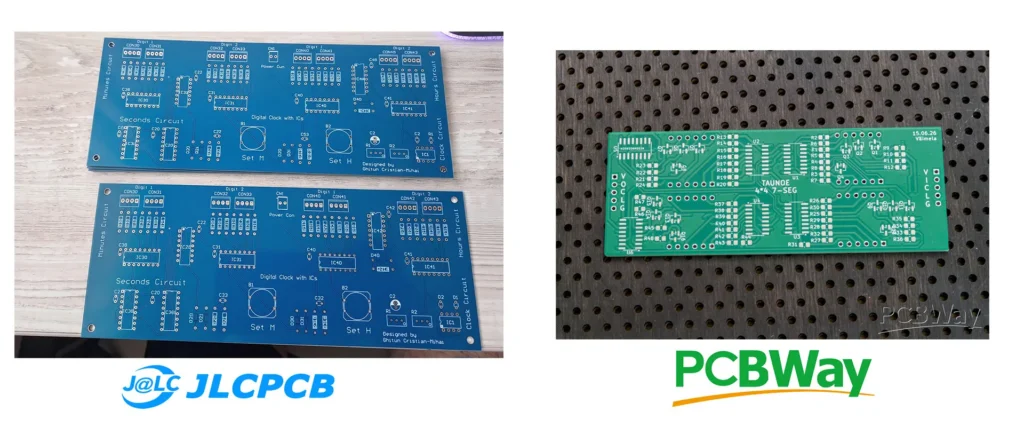
Both suppliers cover ordinary two-layer and multilayer prototypes. For a conventional sensor board or MCU carrier, the first technical question is whether the exact design fits the chosen process.
Published trace and clearance references illustrate why conditions matter:
| Fabrication condition | JLCPCB | PCBWay |
|---|---|---|
| Routine minimum trace/space | 0.10/0.10 mm for one- and two-layer boards at 1 oz copper | General table lists 0.10/0.10 mm; copper weight is not attached to that row |
| Multilayer reference | 0.09/0.09 mm at 1 oz copper | Use the relevant general or advanced process specification |
These are manufacturing limits, not recommended routing targets. Keep wider traces and clearances where the design permits. Do not assume a minimum specified for one copper weight remains available with heavier copper.
Maximum layer count also needs context. A supplier’s 64-layer capability does not make it inherently better for a four-layer prototype. For a controlled-impedance board, the supported stackup and impedance requirements are more useful selection criteria. Both suppliers list impedance-control options.
If the substrate is still undecided, resolve the electrical, thermal, and mechanical requirements first; this PCB material selection guide explains the main choices.
HDI, rigid-flex, and custom fabrication
PCBWay is a practical early shortlist for rigid-flex and extensive custom fabrication, because those processes are explicitly documented in its advanced service. This does not establish exclusive availability or better manufacturing quality.
Its advanced table lists 2/2 mil inner-layer trace/space under a specific H/H oz base-copper condition, limited to local traces rather than the entire board. That capability must not be combined indiscriminately with maximum copper thickness or layer count.
JLCPCB’s September 14, 2026 announcement confirms the launch of HDI PCB manufacturing. Its general fabrication table still contains a conflicting statement that blind and buried vias are unsupported. The announcement establishes HDI availability; it does not establish every possible microvia structure or stackup. Use the HDI service requirements for that design.
For a dense BGA design, make the required via structure, layer transitions, material, and geometry explicit. That gives both suppliers a defined manufacturing problem to evaluate.
Which Is the Better Fit for a Small PCBA Order?
When JLCPCB Economic PCBA fits
JLCPCB Economic is the first assembly route to evaluate when the board fits its restrictions and the BOM is readily available. Its published envelope includes single-sided placement, 2/4/6-layer boards, 0.8–1.6 mm thickness, and 2–50 assembled pieces. Eligible combinations of finish, color, thickness, and quantity are narrower than that overall envelope.
The tier also requires a standard stackup and excludes features such as castellated holes and edge plating. Standard PCBA supports single- and double-sided placement and a broader set of board configurations.
The practical opportunity is to consider assembly eligibility before freezing the layout. If components can comfortably fit on one side, that may preserve access to Economic assembly. Evaluate the design effort involved before changing a working layout merely to pursue a lower setup fee.
When to compare JLCPCB Standard with PCBWay
For double-sided or otherwise ineligible designs, compare JLCPCB Standard with PCBWay’s corresponding assembly service. The Economic headline no longer describes the relevant job.
PCBWay provides turnkey sourcing, fully customer-supplied kits, and a combination in which the customer supplies some parts. JLCPCB offers global sourcing and consignment alongside its stocked and preordered inventory. Having a specialty component outside JLCPCB’s public stock does not automatically eliminate JLCPCB.
At BOM review, identify the parts that determine the decision: unavailable ICs, exact connector variants, components you already own, and substitutions you will accept. A sourcing option is useful only if it can supply the required part in time.
Both suppliers document through-hole and mixed assembly. A board containing through-hole connectors therefore needs a process and price comparison, rather than an assumption that only one supplier can assemble it.
How Long Will the Order Take?
Fabrication, parts readiness, assembly, and shipping
An advertised 24-hour build is a production-stage claim, not a promise of next-day delivery in the US or Europe.
JLCPCB’s September 9 lead-time guide defines SMT time from the arrival of bare boards at the assembly line through assembly, inspection, and packaging. It reports that over 90% of orders complete that stage within 24–48 hours after fabrication, with preparation overlapping board production. This is the supplier’s reported performance, not an independently measured delivery rate.
Its separate capability table lists Economic build time at 1–3 days and Standard at four days or more. Those figures are not clearly reconciled with the newer stage-specific guide, so they should not be collapsed into one universal turnaround promise.
PCBWay’s assembly page promotes 3–5 days. Its capability documentation says the assembly clock begins once parts and required production information are ready.
Parts readiness can outweigh these manufacturing differences. JLCPCB publishes a 9–15-day lead time for global sourcing. A design requiring that route has a different schedule from one assembled entirely from available stock.
What changes the delivered price in the US and Europe?
Compare shipping to the same destination using an acceptable delivery service. Check which taxes—including VAT where applicable—import charges, and carrier fees are included in the displayed amount and which remain payable separately.
For teams with both US and European destinations, calculate each shipment separately. A total for one country is not a reliable substitute for another. The useful deadline is the expected arrival of usable hardware, including component readiness, manufacturing, and transit.
Which Supplier Fits These Three Example Projects?
These are hypothetical selection examples, not tested orders.
| Project | Recommended starting point | What could change the choice? |
|---|---|---|
| Ten conventional two-layer sensor boards, assembled by hand | Start with JLCPCB’s configured bare-board price, then compare PCBWay for the same quantity and destination. | Shipping, selected finish, or a deadline may outweigh the starting fabrication price. |
| Ten single-sided MCU assemblies using stocked parts | Evaluate JLCPCB Economic first. Its eligibility and setup structure suit this scenario. | A second populated side, an unsupported board feature, or a critical stock shortage changes the relevant service. |
| Small rigid-flex assembly run with customer-supplied specialty components | Shortlist PCBWay early for its documented rigid-flex fabrication and assembly options. | The exact stackup, assembly scope, and complete quotation decide suitability; consignment itself is offered by both suppliers. |
The recommendations apply the documented service differences above. They do not establish comparative defect rates, support quality, or guaranteed cost savings.
Before Placing the Order
Complete one final review:
- Fabrication: Gerbers, drill files, dimensions, quantity, finish, copper, and stackup match the order.
- Assembly: The BOM and placement file agree; part numbers, polarity, populated sides, and permitted substitutions are clear.
- Scope: Required inspection, programming, or functional testing is explicitly included where needed.
- Cost and timing: The total covers the required boards and assembly, with shipping, additional charges, parts readiness, and expected dispatch understood.
For a conventional prototype, keep supplier qualification proportional to the task. If a particular certification or confidentiality agreement is a project requirement, resolve it before submitting the production files.
Choose JLCPCB first when your design fits its economical workflow and available inventory. Put PCBWay on the shortlist early when rigid-flex or extensive custom fabrication drives the project. For other small assembly orders, the decisive comparison is the same design, BOM, service scope, and destination.
If you want an additional supplier quotation, share those same files and requirements with LEADHUI PCB’s assembly team.
Frequently Asked Questions
Is PCBWay Better Than JLCPCB?
Neither is universally better. JLCPCB is typically more cost-effective for standard FR-4 prototypes and automated assembly using in-stock library parts. PCBWay excels in rigid-flex boards, heavy copper (up to 8 oz), and custom manual assembly. Note that JLCPCB introduced HDI services in September 2026, making both suitable for microvia designs.
Is JLCPCB Cheaper Than PCBWay?
JLCPCB often has lower advertised entry prices (e.g., $2 for 5 boards via the JLCONE Desktop app vs. PCBWay’s $5 for 10 boards). However, total delivered cost depends heavily on component sourcing, setup fees, and international shipping, which can quickly erase bare-board savings.
Which Is Better for PCB Assembly?
JLCPCB is ideal for simple single-sided prototypes under its Economic PCBA tier, with setup starting at just $8.18. PCBWay is the better choice for double-sided mixed assembly, customer-consigned components, cable harnesses, and full box-build enclosures.
Can JLCPCB and PCBWay Handle Production Orders?
Yes, both handle low-to-medium production. Before scaling up, always request formal quality documentation (such as microsections and test coupons) and confirm component traceability. Running a small qualification pilot lot is strongly recommended before committing to high volumes.
Can I Prototype With One Supplier and Manufacture With Another?
Yes, but you must verify stackups, dielectric materials, and etching tolerances first. Differences in base laminates and manufacturing rules can alter controlled impedance and require adjustments to solder-mask or stencil layers.