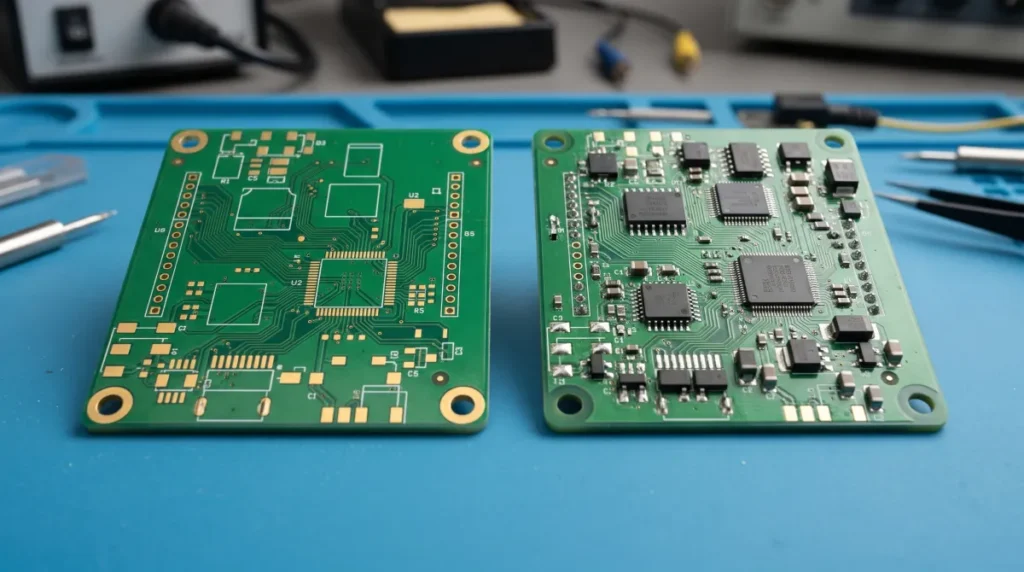
PCB vs PCBA comes down to the deliverable: in a manufacturing order, a PCB commonly means a bare printed circuit board, while PCBA can mean the assembly process or the board after components have been mounted. A populated board is not automatically programmed, functionally tested, or ready to install in a finished product.
The terms overlap because an assembly starts with a fabricated board. Knowing where fabrication ends and assembly begins helps you request the right files, parts, and tests.
Key Takeaways
- A bare PCB provides the physical base and conductive paths; a PCBA adds the specified electronic components.
- Electrical testing of a bare board, optical inspection of an assembly, and functional testing answer different questions.
- State the deliverable, design revision, sourcing responsibility, and agreed test coverage in your request for a quote.
What Is a PCB?
A printed circuit board is the physical structure that supports and electrically connects components. In a bare-board order, it normally has no electronic components mounted on it.
The substrate is the insulating base. Copper traces form paths between connections, while pads provide places to attach parts. Solder mask is the protective coating over much of the copper surface; it leaves selected areas exposed for connections. A bare board can carry electricity and can be checked for electrical faults before assembly.
People sometimes use PCB more broadly for a circuit board even after parts are attached. Siemens’ PCB design explanation distinguishes the board structure from the populated assembly. When requesting PCB fabrication, say “bare boards” if you do not need components installed.
What Is a PCBA?
PCBA can refer to printed circuit board assembly, the process of mounting and soldering components, or to the resulting populated board. Nordic PCB’s terminology guide uses the term for both the process and its result. The intended meaning depends on the conversation, so describe the board and services you need.
An assembly may contain surface-mount components soldered to pads, through-hole components with leads fitted through holes, or both. The mounted parts turn the bare board into an electronic assembly, but their presence alone does not establish that the circuit works.
A PCB assembly service may include component sourcing and inspection; programming and functional testing depend on the agreed project scope. Ask for those activities explicitly when you need them.
PCB vs PCBA: Key Differences at a Glance
| Question | Bare PCB | PCBA |
|---|---|---|
| What is delivered? | An unpopulated circuit board | A board populated with the specified components |
| Main production activity | Fabricating the board and its conductive features | Mounting and soldering components onto a fabricated board |
| Typical information | Board artwork, drill data, and fabrication specifications | Board information plus an approved bill of materials (BOM), placement data where applicable, and assembly instructions |
| Example check | Electrical test for opens and shorts | Visual or optical inspection, with functional tests if agreed |
| Main cost drivers | Material, layers, finish, quantity, and tooling | Board cost if included, plus parts, sourcing, setup, assembly, and agreed checks |
A BOM identifies the components required for the assembly. Depending on the arrangement, the assembler may fabricate the board, arrange fabrication, or quote assembly separately. Confirm the scope rather than assuming all those activities are included.
How Does a PCB Become a PCBA?
The exact route depends on the design and the assembly method, but the transition commonly follows these stages:
- Fabricate the bare board. Produce the board from the approved fabrication data, then carry out the agreed inspections and electrical checks.
- Prepare the parts. Source or receive the components and check them against the approved BOM. Resolve questions about substitutions before installation.
- Assemble surface-mount parts where required. Apply solder paste, place the parts, and use reflow soldering: heat the board so the paste melts and forms solder joints.
- Install through-hole parts where required. Fit and solder components whose leads pass through the board.
- Inspect and test to the agreed plan. Checks may include optical inspection or a customer-defined functional test, depending on the design and order.
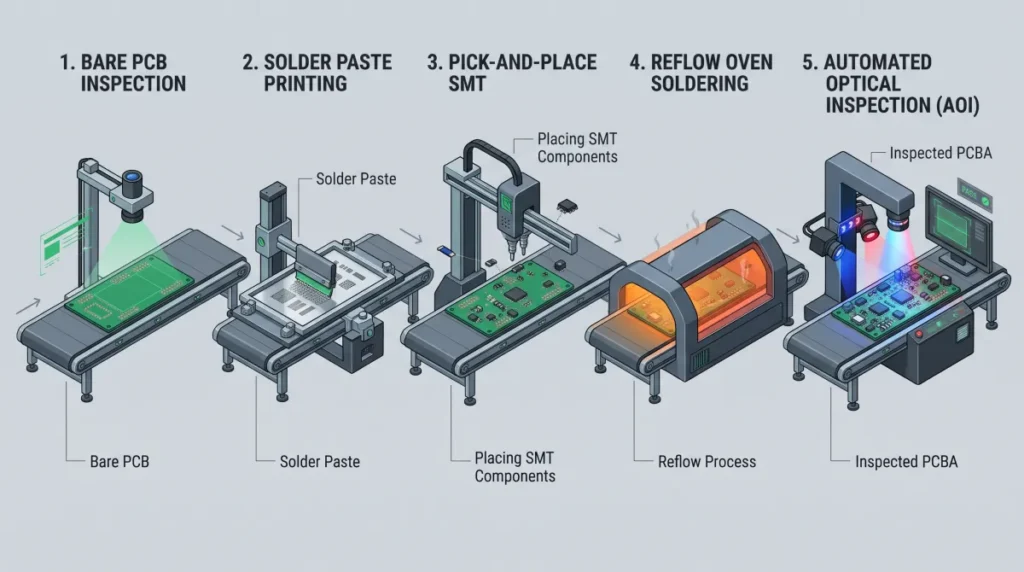
Solder paste, component placement, and reflow belong to assembly; they are not the fabrication of the bare board. For the wider sequence from design release through production, see the industrial PCB production guide.
How Are PCB and PCBA Tests Different?
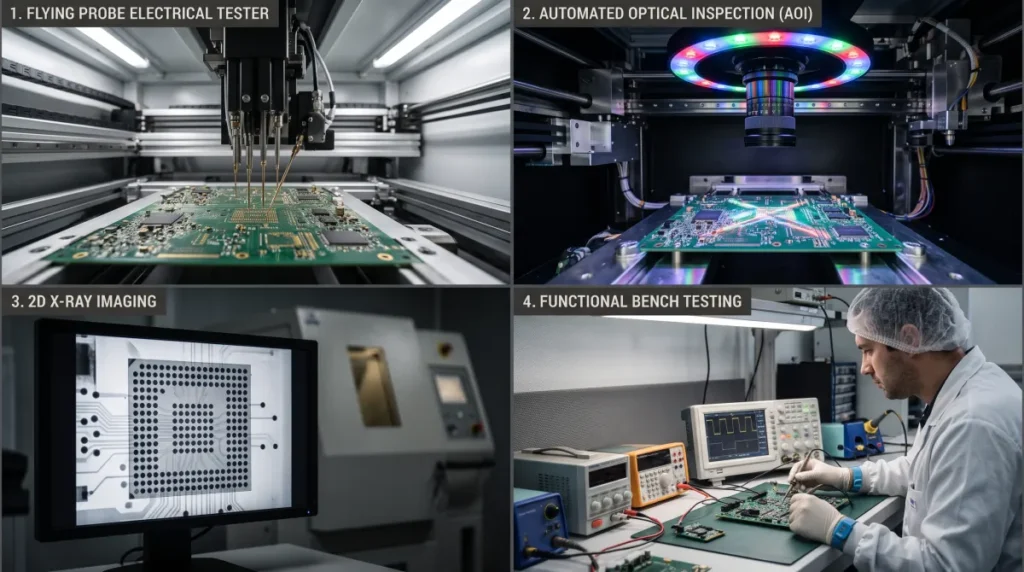
A bare-board electrical test checks connections before components are attached. Assembly inspection looks at features of the populated board. A functional test checks specified behavior under defined conditions. None of these checks proves everything about the finished product.
| Check | What it can establish | What it does not establish |
|---|---|---|
| Bare-board electrical test | Tests for opens and shorts against agreed test data | Whether the populated circuit operates |
| Assembly automated optical inspection (AOI) | Inspects visible features, such as component placement and accessible solder joints | The condition of joints hidden beneath a package or overall circuit function |
| X-ray, when specified | Can reveal selected concealed features, such as solder joints beneath a ball grid array (BGA) package | Whether the circuit performs its intended functions |
| Functional test, when specified | Checks the behavior and conditions in its test procedure | Functions and operating conditions outside that procedure |
An open is an unintended break in a connection; a short is an unintended connection between conductors. Altium’s PCB testing guide, updated in 2025, describes bare-board electrical, optical, X-ray, and functional checks as different methods.
Automated optical inspection can also be used at bare-board fabrication stages; the table describes its assembly use. As LEADHUI’s AOI guide explains, optical inspection cannot directly examine a solder joint hidden under a package. Review the available inspection and testing capabilities and agree on which checks, acceptance criteria, and reports apply to your order.
Which Should You Order? One Project, Two Deliverables
Choose bare PCBs when you need unpopulated boards and will handle assembly separately. Choose PCBAs when you want the specified components mounted before delivery. The following example shows how the request changes for the same design.
Illustrative example: A team needs 100 control boards using fabrication revision B. This is a fictional order, not a customer project, quote, or test result.
| Request | 100 bare PCBs | 100 PCBAs |
|---|---|---|
| Deliverable | Unpopulated revision B boards | Revision B boards populated to the approved BOM |
| Board inputs | Released Gerber files (board-layer fabrication data), drill data, board specifications, and agreed electrical test data | The same released board revision and specifications; confirm that fabrication is included |
| Assembly inputs | None | Approved BOM and placement data as applicable; identify who supplies each component and require approval for substitutions |
| Agreed check | Request an opens/shorts test against the agreed test data | Specify assembly inspection and the functional check below, if required |
For the fictional functional check, the buyer could specify: apply the agreed 5 V supply at connector J1; start the timer when the input reaches the specified voltage range, and confirm that indicator D1 turns on within three seconds. The actual test procedure should identify the input connections and tolerances, any firmware or fixture, and the pass/fail and reporting rules.
A pass on that example confirms the indicator behavior under those specified conditions. It does not demonstrate every input, output, or operating condition. The bare-board electrical test and assembly functional test also cover different stages; request each one you need.
LEADHUI describes assembly using customer-supplied components. If you already have bare boards and want them assembled, ask whether those boards can be accepted. For a more complete request, use the guide to files needed for a PCBA quote.
What Affects PCB and PCBA Cost and Lead Time?
A bare-board quote reflects the board design and fabrication requirements. Material, layer count, surface finish, quantity, and any tooling can all affect the price. For an assembly quote, also consider component cost and availability, sourcing, setup, placement, and any included inspection, programming, fixtures, or tests.
Ask the supplier to separate one-time charges from per-unit costs, and confirm whether the PCBA price includes bare-board fabrication and components. A lower assembly-only price is not directly comparable to a quote that includes the boards and parts.
Lead time also depends on the agreed scope. Part availability, approval of alternatives, engineering questions, test-fixture preparation, and shipping can change the schedule. Confirm which events start the supplier’s quoted lead time.
If an order references industry acceptance standards, identify the applicable document and revision in the purchase requirements. IPC’s standards overview distinguishes IPC-A-600 for printed-board acceptability, IPC-A-610 for electronic assemblies, and J-STD-001 for soldered electrical and electronic assemblies. Agree with the supplier on the standards and requirements that apply to the project.
Frequently Asked Questions
Are PCA and PCBA the same thing?
PCA can mean printed circuit assembly and may refer to a populated board. PCBA is also used for the assembly process or the populated board. Usage varies: describe the physical deliverable and services instead of relying on the acronym alone. Siemens uses PCA for a fully populated board in its PCB design explanation.
Can a bare PCB be tested before assembly?
Yes. A bare-board electrical test can check for opens and shorts against the agreed test data. Its result applies to the electrical coverage of that test; it does not demonstrate how an assembled circuit performs.
Does PCBA always include bare-board fabrication?
No. An assembly quote may include fabrication or cover only part of the work. Confirm who provides the boards and components, which assembly steps are included, and what inspection or testing is covered.
Is a populated PCBA ready to use?
Not necessarily. The assembly may still need firmware, a functional test, an enclosure, system integration, or customer approval. Define those requirements before ordering so the quote and acceptance criteria match the intended use.
Request the Right Deliverable
Whether you need bare-board fabrication or PCB assembly, provide the quantity and released board revision. For an assembly, include the BOM, sourcing plan, and any agreed inspection and functional-test requirements. Ask for a quote that identifies exactly what will be delivered.