Solder flux is a chemical formulation that helps solder wet metal surfaces by removing oxides and limiting renewed oxidation during heating. In printed circuit board assembly, it can be applied separately or supplied inside solder wire or solder paste. The choice affects not only how a joint forms but also what residue remains on the finished board.
Key Takeaways
- Flux helps solder wet a joint; solder alloy supplies the metal that forms the connection.
- Rosin, no-clean, and water-soluble describe flux chemistry or residue behavior. A pen, liquid, gel, wire core, or paste describes how material is supplied.
- A no-clean designation does not settle every coating, contamination, or reliability question. Agree on the complete process and verification requirements before production.
- Water-soluble formulations generally require a qualified cleaning process. Follow the selected product’s instructions and the assembly specification.
What Does Solder Flux Do?
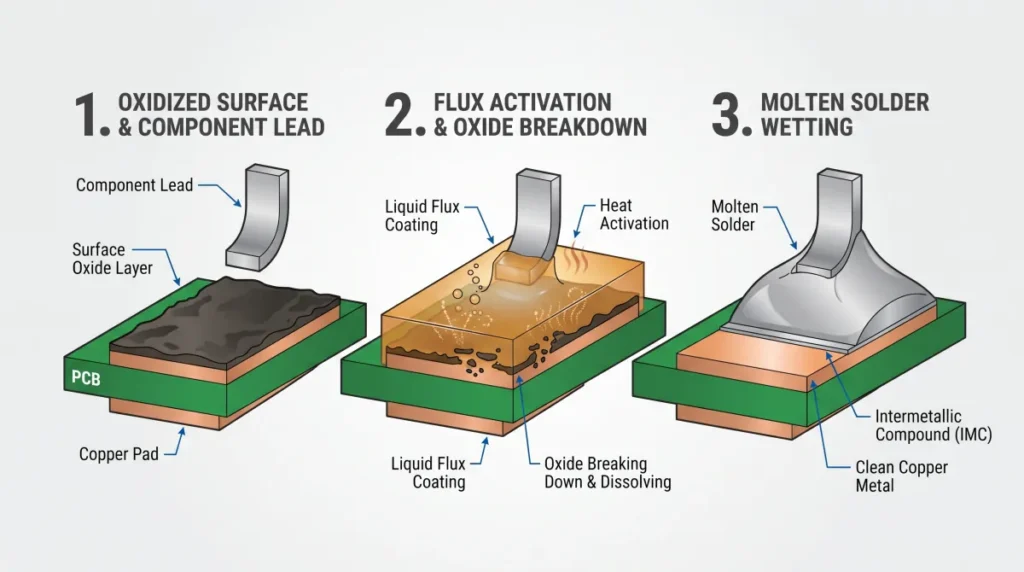
Flux prepares surfaces for soldering and helps maintain conditions in which molten solder can wet them. Copper pads, component terminations, and solder particles can develop oxide films that interfere with contact between the solder and the underlying metal.
During heating, a suitable flux works in several ways:
- Addresses surface oxides. Activators in the formulation act on oxides within the flux’s intended operating conditions.
- Limits further oxidation. The flux medium helps protect exposed surfaces during the soldering operation.
- Supports wetting. With surface barriers reduced, molten solder can spread over compatible surfaces and form a joint.
The flux is only one part of the process. Surface finish, cleanliness, alloy, heat transfer, time, and component condition also affect the result. A poor joint cannot reliably be corrected simply by adding more flux. For the underlying classifications and residue considerations, see Chemtronics’ guide to flux for electronics.
Solder Flux vs. Solder Paste
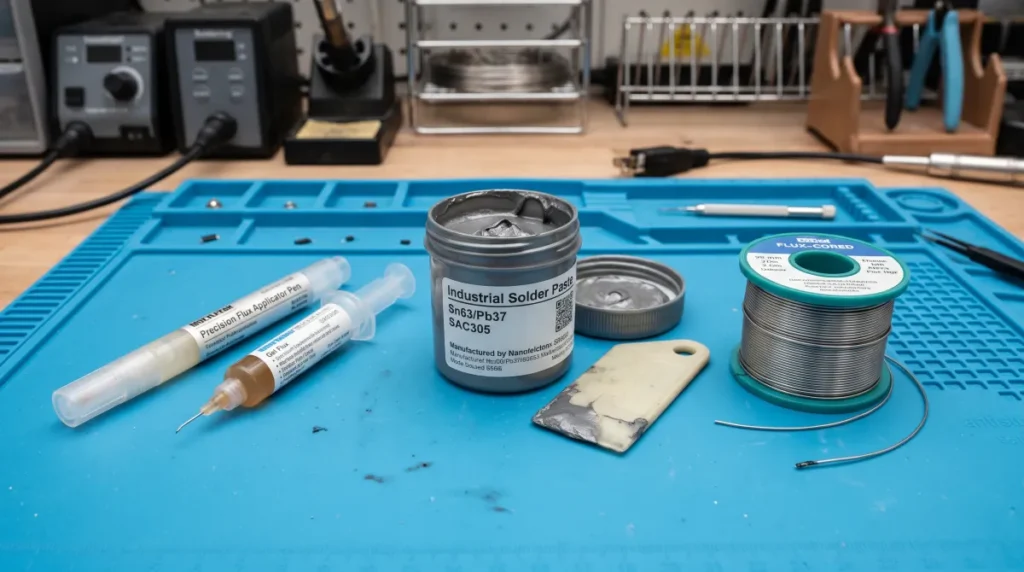
Solder flux and solder paste are related, but they are not interchangeable. Solder paste contains fine solder alloy powder suspended in a flux medium. Separate flux contains no solder alloy to form the joint.
| Material | What it supplies | Common use |
|---|---|---|
| Separate flux | Flux formulation | Hand soldering, rework, wave or selective soldering |
| Flux-cored solder wire | Solder alloy and flux inside the wire | Hand soldering and some rework |
| Solder paste | Solder alloy powder and a flux medium | Stencil printing or dispensing before reflow |
The flux in paste also helps the paste perform during storage, printing, and reflow. Indium’s explanation of solder paste flux describes these roles. A flux-cored wire may supply enough flux for a particular task, but difficult rework or a specific procedure can call for additional compatible flux.
Types of Solder Flux and Their Residues
The most useful comparison starts with the product data sheet: what the flux is intended to do, what remains after soldering, and how that residue should be handled. The common labels below can overlap; they are not a single set of mutually exclusive chemistry classes.
| Description | Typical consideration | Residue and cleaning |
|---|---|---|
| Rosin or resin based | Used in many electronics soldering formulations; activity varies by product | Residues vary. Follow the product instructions and the assembly’s cleanliness requirements. |
| No-clean | Designed for a process in which specified residues may remain after soldering | Leaving residue may be acceptable when the complete process and application are qualified. Cleaning may still be required for a particular product or downstream operation. |
| Water-soluble | Designed so residues can be removed using an appropriate water-based process | Generally requires cleaning after soldering; the equipment, timing, water quality, and drying method depend on the product and process. |
| Inorganic or acid flux for plumbing | Often formulated for aggressive cleaning of other metalwork | Do not substitute plumbing flux for an electronics-qualified product; unsuitable residues can damage an assembly. |
How flux classifications help
IPC J-STD-004 classifies flux materials by composition and other tested characteristics, including activity and halide designation. For example, ROL0 denotes a rosin-based (RO), low-activity (L) flux with the standard’s 0 halide designation. The designation is defined by the applicable test criteria; it should not be interpreted as a guarantee that every trace of halide is absent. This classification does not by itself prove compatibility with a particular board, coating, cleaning process, or service environment. Consult the applicable edition and the material supplier’s documentation for the exact definitions.
The IPC J-STD-004B table of contents and classification excerpt is a useful starting point; use the edition specified for the work when making a purchasing or acceptance decision.
How to Choose Flux for PCB Assembly
Choose the flux together with the soldering process and the intended residue strategy. A material that wets well in isolation may still be a poor choice if its residue cannot be removed beneath the components, interferes with coating, or falls outside the customer’s cleanliness requirements.
| Assembly situation | Questions to settle with the assembler |
|---|---|
| General-purpose electronics | Which flux and process are qualified? Are residues intended to remain? What product documentation applies? |
| Assembly requiring cleaning | Can the board, components, connectors, and labels tolerate the cleaner, temperature, rinsing, and drying process? Can cleaner reach and leave low-clearance areas? |
| Board receiving conformal coating | Are the residue and coating compatible? Does the coating supplier require cleaning or an adhesion assessment? |
| Sensitive or high-reliability assembly | What operating environment, acceptance standard, test method, and records are required? How will changes in material or process be controlled? |
Do not assume that water-soluble is automatically cleaner or that no-clean is automatically suitable without cleaning. Both depend on executing and validating the intended process. A board with closely spaced conductors, low-standoff packages, or moisture exposure may need a more detailed contamination assessment than a simple prototype.
Share the intended service environment, surface finish, solder alloy, soldering methods, and any downstream coating or encapsulation plans with the assembly provider. The PCB assembly process explains where these choices fit in the wider build.
How Flux Is Applied in Soldering Processes
Flux delivery changes with the process. The form in which flux is supplied should not be confused with its chemistry or cleaning classification.
Hand soldering and rework
Flux-cored wire supplies alloy and flux together. A technician may also use a compatible pen, liquid, or gel when the procedure calls for it, such as during component removal or fine-pitch rework. Apply only what the product instructions and process require; excessive residue can make inspection or subsequent cleaning harder.
Soldering fumes can harm health. The UK Health and Safety Executive identifies rosin-based flux fume as a cause of occupational asthma and recommends controlling exposure with suitable, maintained extraction. Follow the flux and cleaner safety data sheets and your workplace procedures for ventilation, protective equipment, handling, and disposal. Lead-free solder does not eliminate flux fumes.
SMT reflow
In surface-mount assembly, solder paste is typically printed or dispensed onto pads before components are placed. The paste’s flux acts during heating, and the alloy melts to form the joints. Paste handling and the thermal profile must match the material and assembly. For the oven stages and profile trade-offs, see the reflow soldering guide.
Wave and selective soldering
Flux can be applied before the board encounters molten solder. The equipment, coverage, heating, and residue strategy are selected for the flux and assembly. Mixed-technology boards may encounter more than one flux during manufacture or rework, so compatibility between those materials matters.
Does Flux Residue Need to Be Cleaned?
Flux residue needs to be cleaned when the selected material’s instructions, the product specification, or a qualified downstream process requires it. A no-clean label indicates the product is designed for use without a routine cleaning step under suitable conditions; it is not a blanket guarantee for every board and environment.
Before deciding to leave or remove residue, check:
- Material instructions: Does the flux supplier prescribe cleaning, a compatible cleaner, or a time window?
- Assembly requirements: Does the customer specify a cleanliness method, standard, acceptance criterion, or documented result?
- Downstream operations: Can residue affect coating adhesion, encapsulation, contact surfaces, test access, or other operations?
- Cleaning access: Can the process reach under low-clearance parts and remove the dissolved residue, then rinse and dry the assembly adequately?
- Verification: What evidence demonstrates that the selected process meets this product’s requirements?
Cleaning a no-clean residue is not automatically an improvement. Indium’s no-clean flux guidance cautions that incomplete removal can leave exposed residue and recommends a compatible cleaning process when removal is necessary. Qualify the entire cleaning and drying process rather than assuming a quick solvent wipe is sufficient.
How is cleanliness verified?
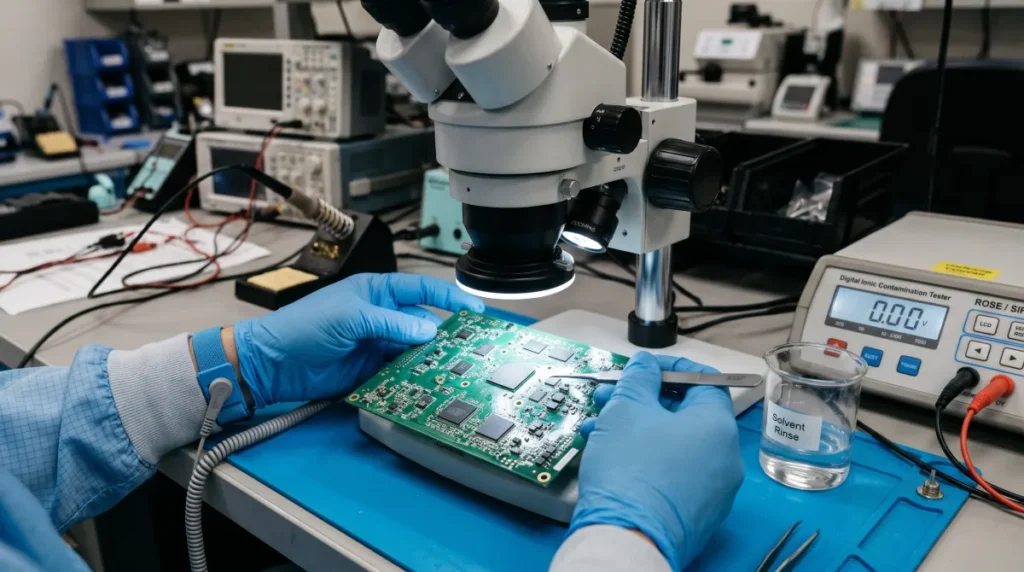
Visual inspection can reveal obvious deposits, but a board that looks clean is not necessarily free of contamination that matters electrically. Different tests answer different questions:
- ROSE testing assesses extractable ionic contamination as a bulk measurement under a defined method. IPC test method 2.3.25, revision D describes it as a process-control tool that does not identify individual ionic species or predict reliability.
- Ion chromatography can identify and quantify selected ionic species in an extract. IPC test method 2.3.28, revision B describes the method and cautions that its extraction procedure may damage some assemblies.
- Surface insulation resistance (SIR) testing measures electrical resistance under specified conditions and can help assess residue-related electrical behavior. Indium’s explanation of SIR describes its use in flux evaluation.
Agree on the method, sampling, limits, and any product-specific qualification before building. Do not borrow a single numerical limit from an unrelated assembly. The IPC J-STD-001 guide explains why the specified revision, product class, and agreed evidence matter.
A Worked Example: Specify Flux and Cleaning Before Ordering
Consider an illustrative industrial controller that will receive conformal coating and operate in a humid environment. This is a planning example, not a tested build or a recommendation for a particular material.
Instead of writing only “use no-clean flux,” the buyer can send the assembler a short requirements package:
- Assembly and process: Identify the board revision, surface finish, solder alloy, and planned reflow, through-hole, and rework operations.
- End use: Describe humidity exposure and any sensitive electrical spacing or other reliability requirements.
- Downstream operation: Identify the coating material and areas that must remain uncoated or electrically accessible.
- Flux and residue: Ask which materials are proposed at each soldering stage and whether their residues will remain or be removed.
- Evidence and acceptance: Agree on relevant material documentation, cleaning and coating compatibility checks, test method, acceptance criteria, and records before production.
- Change control: Agree when a change of flux, cleaner, profile, or coating process triggers review or requalification.
The assembler and coating supplier can then determine whether the chosen materials and process are compatible. The point is to make the decision traceable before parts are built, not to prescribe cleaning or a specific test for every board.
Common Flux-Related Problems
| Symptom | Possible causes | Useful next check |
|---|---|---|
| Solder does not wet a pad well | Oxidation, surface finish issues, insufficient heat, unsuitable or exhausted flux | Review surface condition, material shelf life, and the actual heating profile. |
| Visible residue remains | Flux formulation, amount applied, heating, or cleaning process | Identify the material and compare the residue with the product and customer requirements. |
| Coating adhesion is inconsistent | Residue, other contamination, coating preparation, or cure conditions | Review flux/coating compatibility and the qualified cleaning and coating process. |
| Residue remains beneath a low-standoff part after cleaning | Limited fluid access, inadequate rinsing, or an incompatible cleaner | Evaluate access, cleaning chemistry, rinse and drying conditions, and product-specific verification. |
These are investigation paths, not diagnoses. For process control before reflow, solder paste inspection can help identify printing problems that a flux change alone will not solve.
Solder Flux FAQs
Is solder flux conductive?
The answer depends on the formulation, processing, residue, and environment. Some residues are intended to remain after a qualified no-clean process, but moisture, contamination, incomplete processing, or other conditions can affect electrical behavior. Evaluate the complete assembly rather than assuming every residue is either conductive or harmless.
Can you solder without adding separate flux?
Yes. Flux-cored solder wire and solder paste already contain flux, so a separate application may not be needed for a particular operation. Follow the material instructions and the applicable soldering or rework procedure.
Is no-clean flux residue always safe to leave on a PCB?
No. No-clean products are designed for residues to remain under appropriate conditions, but the finished assembly, service environment, downstream coating, and customer requirements still matter. Validate the process for its intended use.
Can plumbing flux be used for electronics?
Do not use plumbing flux as a substitute for an electronics-qualified flux. Select a material intended for electronic assemblies and follow its residue and cleaning instructions.
Is solder paste the same as flux paste?
Not necessarily. Solder paste contains alloy powder and a flux medium. A product sold as a flux paste or gel may contain flux without solder alloy. Read the product label and data sheet before use.
Plan the Flux and Residue Strategy Together
A reliable soldering process starts with a compatible material, suitable heating, and a clear plan for the residue left behind. Define those choices along with coating, cleaning, verification, and acceptance requirements before ordering the assembly.
For a new build, discuss the board design and process requirements with a PCB assembly provider and include any special documentation or cleanliness expectations in the order.