Fabrication de PCB
Ici, vous pouvez acquérir des connaissances professionnelles couvrant toute la chaîne, de la conception PCB à l'assemblage, ainsi qu'une analyse précise des dernières tendances de l'industrie électronique.
Industrial PCB Production: Process & QA
Industrial PCB production turns an approved circuit-board design into bare boards and, when ordered, populated assemblies for industrial equipment. The route includes fabrication, component assembly, inspection and agreed testing. Approval depends on the specified build, operating conditions and acceptance criteria. A motor controller, sensor interface and cabinet-mounted control board can require different materials, mechanical support…
PCB HDI : empilage, microvias et conception
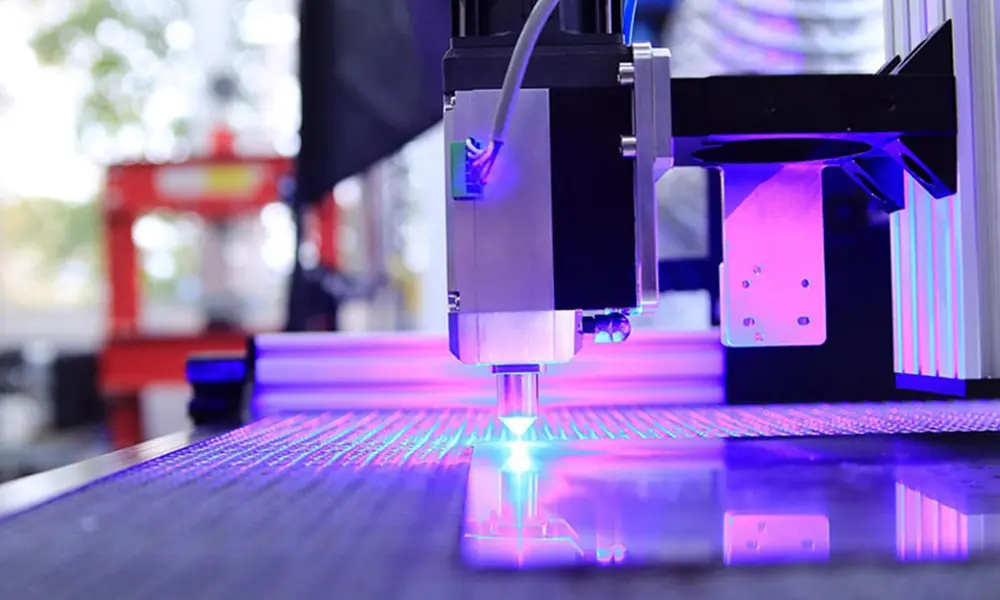
An HDI PCB, or high-density interconnect printed circuit board, uses fine conductors and compact interlayer connections to fit more wiring into a given area. Laser-drilled microvias and thin buildup layers help connect dense component pads without using a full-thickness hole at every connection. The design question is whether those features solve a routing constraint worth…

PCB rigide : matériaux, construction et choix de conception
A rigid PCB, or rigid printed circuit board, supports components and connects them through copper conductors on a substrate designed to retain its shape in service. It suits electronics whose circuitry stays fixed within an enclosure, rather than bending during use. Choosing one means matching its construction to the circuit, mounting, connectors and environment. Layer…

Circuit imprimé flexible : types, matériaux, empilage et règles de conception
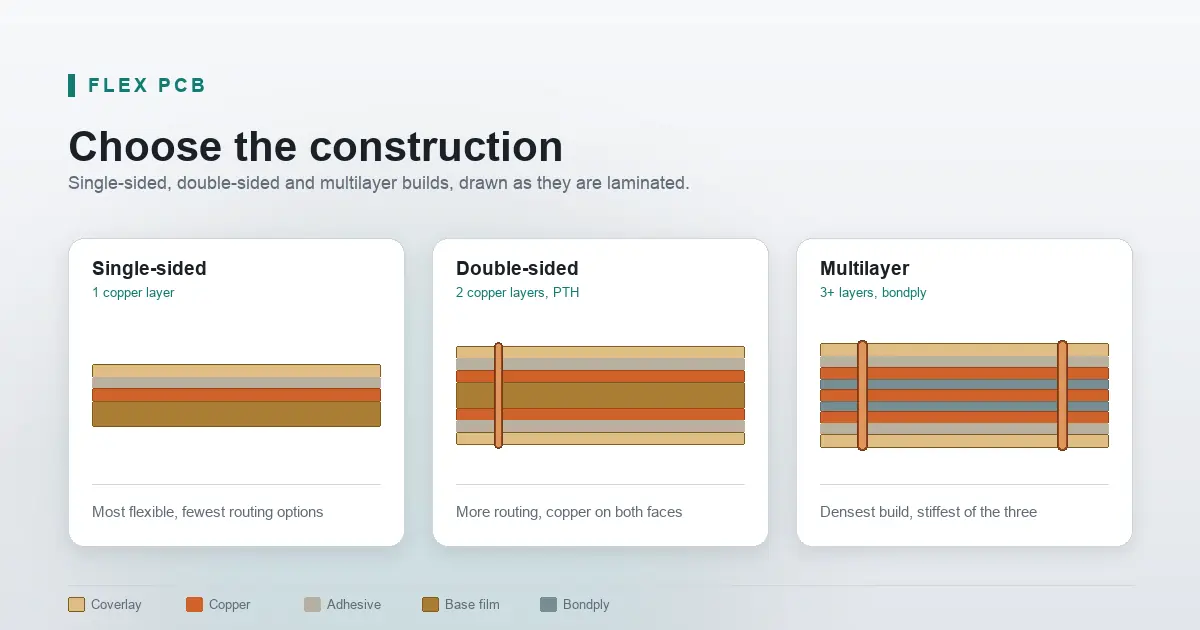
A flex PCB is a circuit built on a flexible polymer film, usually polyimide, with copper conductors bonded to it and a coverlay protecting them. That is the definition, and it is the part already answered above the search results. It is not the part that decides whether your build works. Four questions decide that,…
Rayon de courbure d’un circuit imprimé flexible : comment le calculer et le spécifier
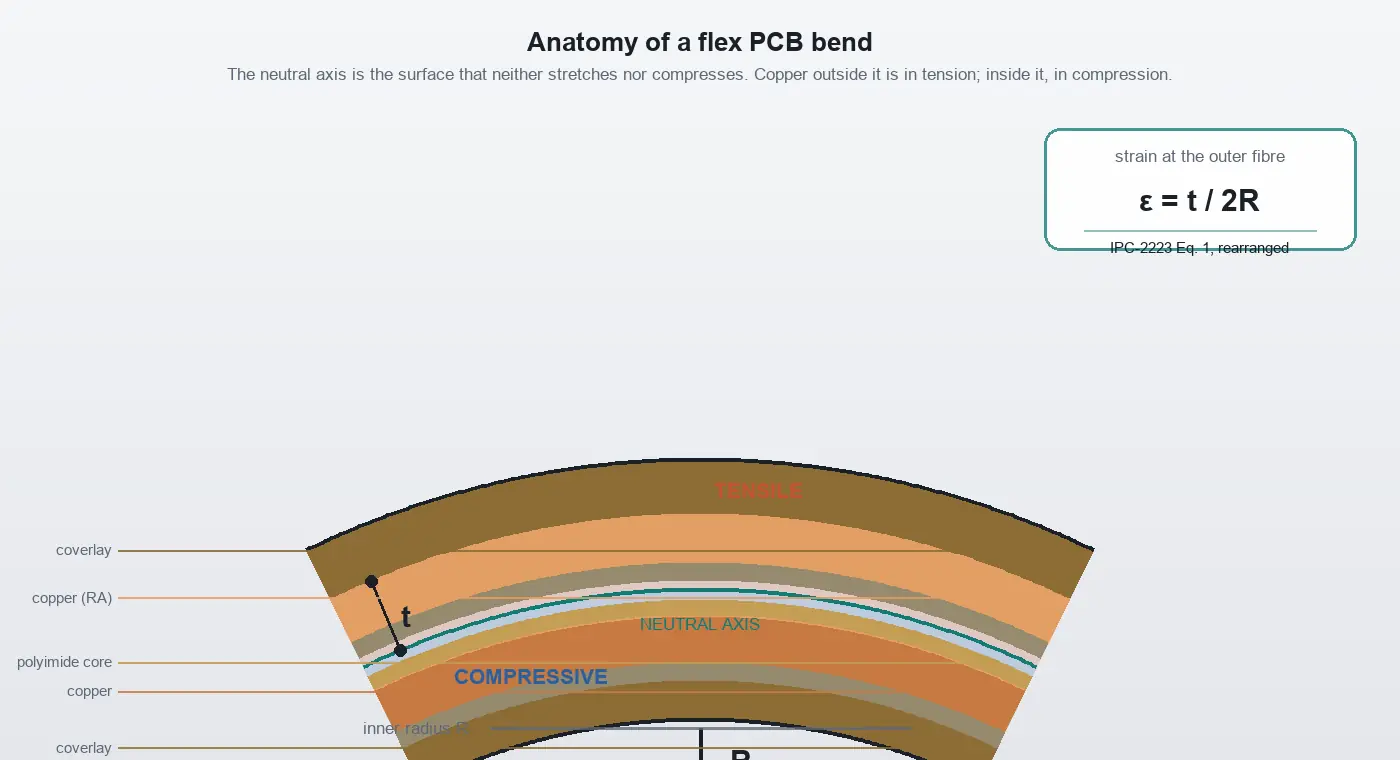
You have a stackup, a housing envelope, and a mechanical engineer asking for a flex PCB bend radius. The answer is not a lookup table; it is a strain calculation, and the multipliers in the tables are what that calculation returns once you fix a stackup. Every published multiplier, whether it reads 6×, 10×, 12×,…
Guide du brasage par refusion : procédé, profil et défauts
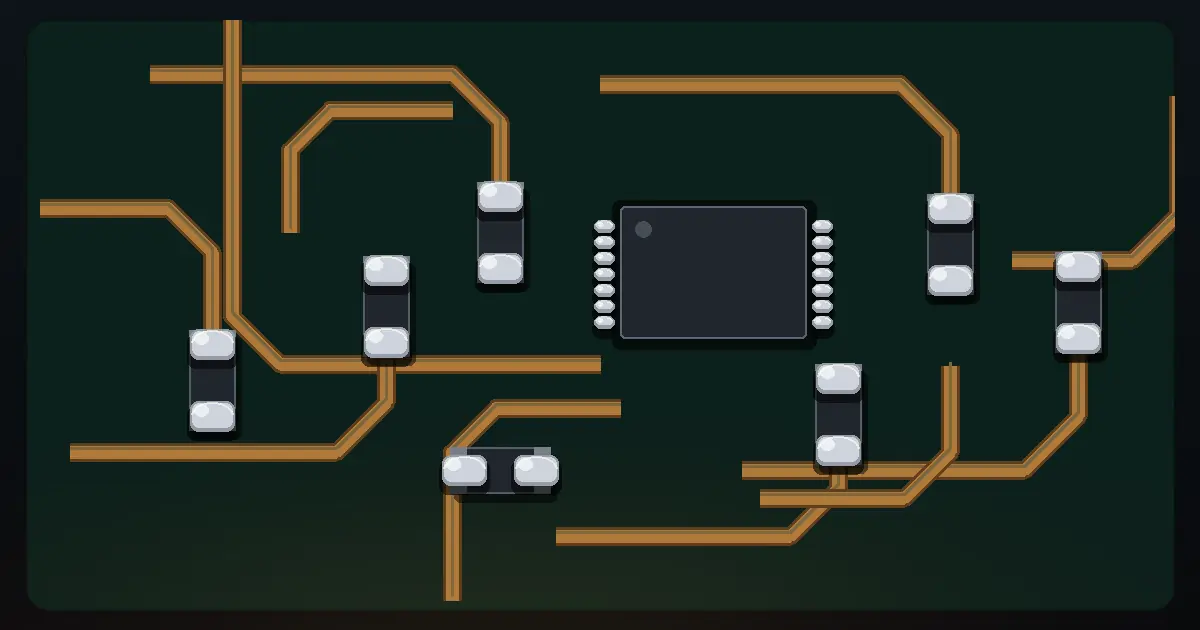
Reflow soldering is the process that attaches surface-mount components to a printed circuit board by heating stencilled solder paste until it melts, wets the component terminations and forms the joint on cooling. It is the primary assembly method for almost every modern electronic product, and it is the step where the most expensive mistakes become…
Stratifié cuivré (CCL) : types, fabrication, performances et normes
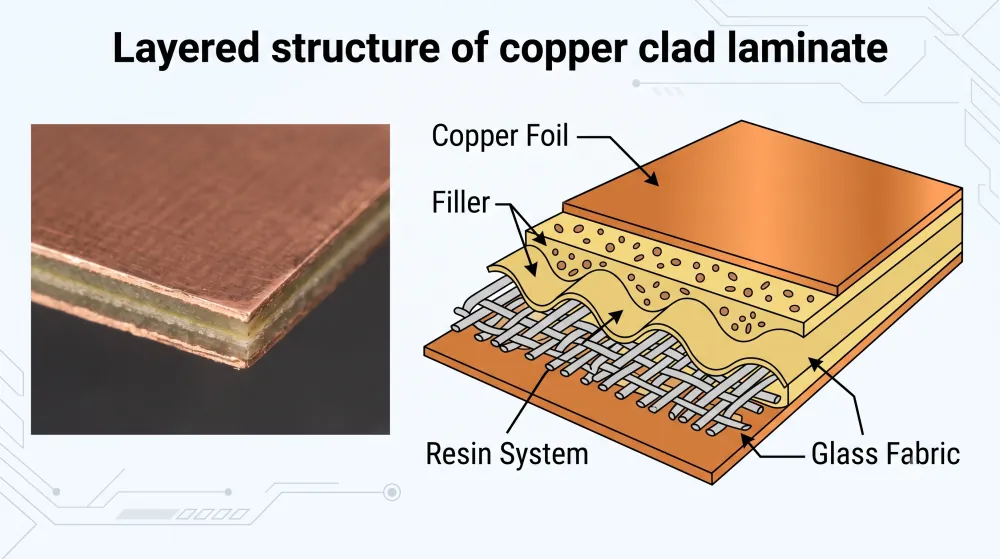
Copper clad laminate, or CCL, is a base material from which PCB conductors are formed. It consists of copper foil bonded to an insulating material such as cured glass-reinforced epoxy, a flexible polymer film, or a thermally conductive dielectric on a metal base. In a conventional multilayer rigid PCB, patterned CCL commonly becomes a core.…
JLCPCB vs PCBWay : quel fabricant de PCB convient à votre projet ? (2026)
For a straightforward PCB prototype or a small assembly order that fits JLCPCB’s Economic PCBA rules, start with JLCPCB, especially when the components are already in its inventory. For rigid-flex or extensive custom fabrication requirements, shortlist PCBWay early. These recommendations follow from JLCPCB’s economical assembly tier and PCBWay’s documented advanced manufacturing options. The JLCPCB vs…

What Is a Through Hole? PCB Types, Uses, and Design Guide
A through hole is an opening that passes completely from one side of a printed circuit board (PCB) to the other. It may be plated with conductive copper to create an electrical connection, or left unplated for mechanical use. Through holes are commonly used for component leads, connectors, vias, mounting hardware, alignment pins, and slots.…

Guide des matériaux PCB : types, propriétés et sélection
Le matériau du PCB affecte bien plus que la résistance physique d’une carte de circuit imprimé. Il influence l’impédance, la perte de signal, la dissipation thermique, la stabilité dimensionnelle, la fiabilité d’assemblage, la fabricabilité, le délai de livraison et le coût. Un matériau qui fonctionne bien pour un contrôleur de base peut échouer dans un module radar à 77 GHz, une carte LED à courant élevé ou un dispositif médical rigide-flexible.…

Liste de contrôle de qualification des fournisseurs PCB [Guide 2026]
Une liste de contrôle de qualification des fournisseurs PCB aide les ingénieurs et les acheteurs à vérifier si un fabricant de PCB, un fournisseur PCBA ou un partenaire EMS peut répondre aux exigences techniques, qualité, livraison et documentation du produit avant le début de la production. L'ISO décrit l'ISO 9001:2015 comme une norme de gestion de la qualité mondialement reconnue pour améliorer les performances et maintenir un système de management de la qualité (ISO, 2026). Dans…
Liste de contrôle DFM PCB
Une liste de contrôle DFM PCB aide les ingénieurs et les acheteurs à détecter les problèmes de fabricabilité avant qu'une carte ne soit chiffrée, fabriquée, assemblée ou libérée en production. L'objectif est de confirmer que le fournisseur peut fabriquer le design avec l'empilement, les tolérances, la finition, le plan de test et la documentation requis. La revue DFM réduit les blocages techniques et aide les acheteurs à comparer les fournisseurs. Si…