Flex PCB
LEADHUI PCB provides custom flex PCB manufacturing for products that require lightweight structure, bendability, compact layout, and reliable interconnection in limited spaces. Flexible circuit boards are widely used in electronics that need to fold, bend, or fit into tight mechanical structures where standard rigid boards are not suitable.Thermal Conductivity Options: 1.0–3.0 W/m.KGet A Quote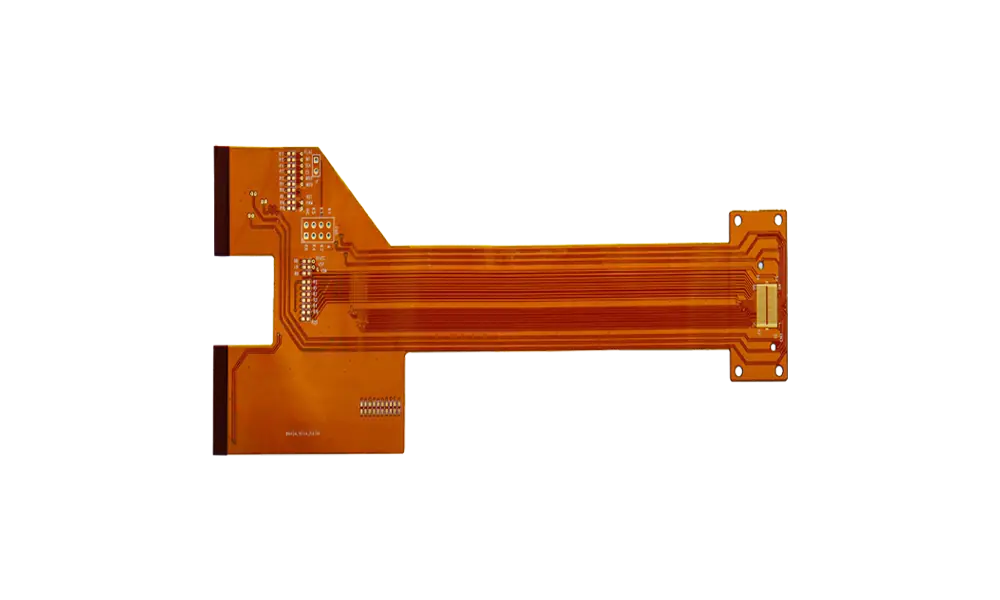
Flex PCB Types We Support
We manufacture four distinct types of aluminum-backed PCBs to match your specific thermal, layering, and spatial layout requirements.

Single-Sided Flex PCB
Single-sided flex PCBs have one conductive layer and are commonly used in simple, lightweight, and space-saving electronic applications.
- Layer Count:
- Best For:
- Cost Level:
Double-Sided Flex PCB
Double-sided flex PCBs have conductive layers on both sides and support more complex routing than single-sided structures.
- Layer Count:
- Best For:
- Cost Level:
Multilayer Flex PCB
Multilayer flex PCBs are used for more advanced circuit designs that require higher routing density and compact form factor.
- Board Type:
- Best For:
- Cost Level:
Dynamic Flex PCB
Dynamic flex PCBs are designed for repeated bending or movement during operation, such as in moving assemblies or hinged devices.
- Board Type:
- Best For:
- Cost Level:
What Is a Flex PCB?
A flex PCB, or flexible printed circuit board, is a circuit board built on flexible substrate material, usually polyimide, instead of rigid FR4. This allows the board to bend, fold, and fit into three-dimensional product structures while maintaining electrical connectivity.
Flex PCBs are often used to replace:
- Wire harnesses
- Ribbon cables
- Multiple rigid boards connected by cables
- Interconnect systems in compact products
Because of their flexibility and lightweight design, flex PCBs can simplify product structure and improve mechanical integration.
Why Choose Flex PCB?
Flex PCB Applications
From rapid prototyping to high-volume mass production, LEADHUI supports a wide range of custom specifications to match your exact project needs:
| Capability Item | Specification |
|---|---|
| Flex PCB Type | Single-Sided Flex PCB, Double-Sided Flex PCB, Multilayer Flex PCB, Static Flex, Dynamic Flex, Custom Flex PCB |
| Base Material | Polyimide flexible substrate and related flex circuit materials according to project requirements |
| Layer Count | Single-sided, double-sided, and multilayer flexible circuit structures available upon review |
| Copper Type | RA copper, ED copper, and custom copper options available upon project requirements |
| Copper Thickness | Standard and custom copper thickness options available depending on bend and current requirements |
| Stiffeners | PI, FR4, stainless steel, and other stiffener options available upon project requirements |
| Coverlay | Flexible coverlay and protective materials available according to board structure |
| Surface Finish | ENIG, HASL, Lead-Free HASL, OSP and other finishes upon review |
| Profile Processing | Routing, laser cutting where applicable, slots, openings, reinforcement areas, custom outlines |
| Testing | Electrical Test, Visual Inspection, Dimension Inspection, Final Quality Inspection |
Flex PCB FAQ
What is the main advantage of flex PCB?
The main advantage is flexibility. Flex PCBs can bend and fit into compact product structures while reducing wiring and connector complexity.
What is the difference between flex PCB and rigid PCB?
Rigid PCBs are built on solid substrate materials such as FR4, while flex PCBs use flexible materials that allow bending and folding.
Can flex PCB be used in moving applications?
Yes. Flex PCBs can be designed for dynamic movement, but repeated bending requires careful design of materials, copper routing, and bend radius.
Where are flex PCBs commonly used?
Flex PCBs are commonly used in wearable devices, medical electronics, cameras, industrial electronics, automotive systems, portable products, and compact consumer devices.
Can LEADHUI PCB support flex PCB assembly?
Flex PCB assembly can be supported according to board structure, stiffener design, component placement, and testing requirements.