IPC-A-610 is the acceptance standard that decides whether a finished printed circuit board assembly is good enough to ship. It is the document your contract manufacturer’s inspectors work from, the one your quality team argues about, and the one your purchase order probably cites without you ever having read it.
Most engineers meet IPC-A-610 the same way: someone senior says “this needs to be Class 3” and the conversation moves on. What that sentence actually commits you to is rarely explained. This guide covers what the standard governs, how its three product classes differ, what tightened between Class 2 and Class 3, and how to specify it correctly on an RFQ so the criteria are not disputed at final inspection.
Key Takeaways – IPC-A-610, Acceptability of Electronic Assemblies, sets visual and workmanship acceptance criteria for finished assemblies. It does not govern how you build them, and it does not cover bare boards. – Every condition is graded as one of three states: Acceptable, Process Indicator, or Defect. The middle category is the one most people miss, and misunderstanding it either inflates your cost or hides process drift. – The three product classes (Class 1, Class 2, Class 3) are chosen by consequence of failure, not by product category. Class 2 is the default for commercial and industrial electronics; Class 3 is for work where failure is not acceptable. – Always cite the revision and the class together, for example “IPC-A-610J Class 3”. Acceptance criteria differ between revisions, so an uncited standard is an argument waiting to happen.
What Is IPC-A-610?
IPC-A-610, formally titled Acceptability of Electronic Assemblies, is published by IPC, now operating as IPC International Inc. under the name Global Electronics Association. It is the most widely used acceptance standard in electronics manufacturing, and it defines the visual and workmanship criteria that a finished printed circuit board assembly (PCBA) must meet to be accepted.
The standard exists to settle one question objectively: does this assembly meet the agreed workmanship level? It covers solder joint quality, component placement and orientation, cleanliness, conformal coating, mechanical integrity, and marking. Inspectors, quality engineers, and EMS providers use it as the shared reference for accepting or rejecting work, which is what stops acceptance from becoming a matter of opinion between a buyer and a supplier.
Three things about scope matter before anything else:
- It governs finished assemblies, not the process used to build them. That is J-STD-001’s job.
- It does not cover bare boards. Bare board acceptability is IPC-A-600.
- It is a specification you cite, not a certification you hold. People and trainers earn certification against it. A company does not “get IPC-A-610 certified.”
What IPC-A-610 does not cover
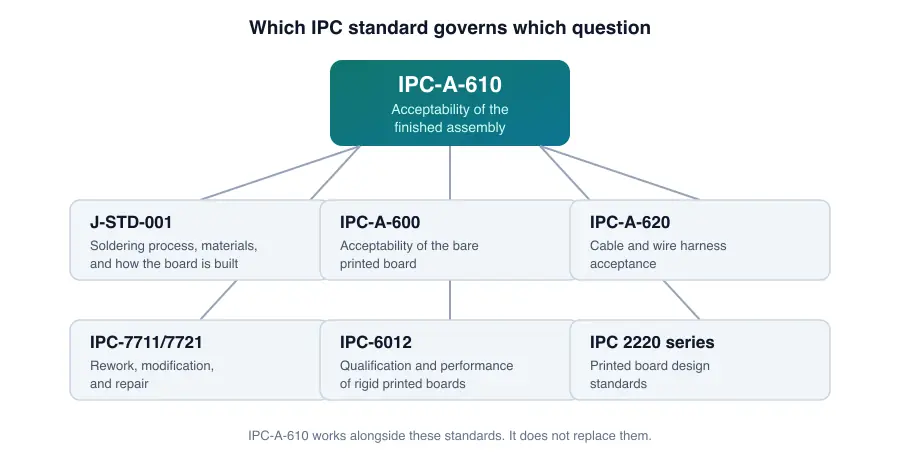
The most common source of confusion on a PCBA programme is assuming IPC-A-610 answers a question it was never written to answer. This table maps what it delegates.
| Topic | The standard that actually governs it |
|---|---|
| Soldering process, materials, and how to build | J-STD-001 |
| Bare printed board acceptability | IPC-A-600 |
| Rigid printed board qualification and performance | IPC-6012 |
| Cable and wire harness workmanship | IPC-A-620 |
| Rework, modification, and repair | IPC-7711/7721 |
| X-ray inspection and cross-section evaluation | J-STD-001 |
| How to fix a defect once found | IPC-7711/7721 |
| Printed board design | IPC 2220 series |
IPC-A-610 works alongside these rather than replacing them. In practice, a J-STD-001 certified operator builds the board and an IPC-A-610 certified inspector decides whether the result is acceptable.
One boundary in that table is worth stating separately, because it surprises people: the standard showing you a defect does not mean the standard is telling you how to fix it. The presence of a criterion does not authorise or require any particular corrective action. Repair authority sits in IPC-7711/7721.
How IPC-A-610 Grades Criteria: Acceptable, Process Indicator, Defect
IPC-A-610 does not grade conditions as a simple pass or fail. Every condition it evaluates falls into one of three states, and the difference between the second and third is where most commercial disputes start.
| Condition | What it means | What you do about it |
|---|---|---|
| Acceptable | Meets the criteria for the specified class | Accept the assembly |
| Process Indicator | A condition that does not affect form, fit or function | Monitor as process data; disposition of the individual unit is not required |
| Defect | Does not meet the criteria for the specified class | Disposition required: rework, scrap, or a documented concession |
Critical Change: The “Target” category was eliminated
Many older inspection forms and industry templates still refer to four conditions: Target, Acceptable, Process Indicator, and Defect. The Target condition was officially removed in Revision H (2020) and remains absent in Revision J. Modern IPC-A-610 evaluation uses only three classifications. If a supplier’s incoming inspection or reporting documentation still relies on a “Target” column, they are operating against a standard superseded over four years ago.
A Process Indicator is the category most people miss. It is not a rejection. IPC defines it as a condition that does not affect the form, fit or function of the product, and the guidance is that these conditions should be monitored as part of process control: when their number indicates abnormal variation or an undesirable trend, the process should be analysed. Disposition of the individual unit is not required, and affected product should be used as is. Rejecting units for Process Indicators inflates your cost and your scrap rate without improving reliability. Treating them as fully acceptable means you stop noticing the trend until you are reworking boards in volume.
The classes stack. A defect at Class 1 is automatically a defect at Class 2 and at Class 3. A defect at Class 2 is automatically a defect at Class 3. The practical consequence is that the same physical condition can be Acceptable at Class 1, a Process Indicator at Class 2, and a Defect at Class 3. The higher class inherits every rejection below it and adds its own.
Why the Process Indicator category matters for cost
The commercial consequence runs in both directions, and it is the reason this section exists.
An EMS provider that rejects every Process Indicator is charging you for inspection rigour you did not ask for, and scrapping boards that meet your specified class. A provider that treats Process Indicators as invisible is letting its solder profile, stencil cleaning, or placement accuracy drift without telling you. Neither behaviour is visible from the outside unless you know the three categories exist and ask which one a given condition falls into.
When you discuss inspection criteria with a supplier, ask how they disposition Process Indicators specifically. The answer tells you whether they understand the standard or are applying a stricter, more expensive reading of it than your product needs.
What Are the Three IPC-A-610 Product Classes?
IPC-A-610 divides assemblies into three product classes based on the consequence of failure, not based on what kind of product it is. The same board design can be built to any of the three, and which one applies is a decision about the end use.
| Class 1 | Class 2 | Class 3 | |
|---|---|---|---|
| Official name | General Electronic Products | Dedicated Service Electronic Products | High Performance/Harsh Environment Electronic Products |
| Failure consequence | Minor inconvenience | Undesirable but not catastrophic | Unacceptable |
| Criteria strictness | Most lenient | Intermediate | Most stringent |
| Inspection regime | Sampling, visual | Sampling plus defined verification points | Most extensive verification and documentation |
| Typical applications | Toys, short-life consumer goods | Industrial controls, telecoms, commercial computing, non-safety automotive | Medical, aerospace, defence, safety-critical systems |
| Relative cost | Lowest | Moderate | Highest |
Class 1: General Electronic Products
Class 1 applies where the primary requirement is that the product functions. Cosmetic imperfections and minor workmanship variation are acceptable provided the assembly operates as intended, and the operating environment is benign. Typical examples are consumer toys, simple household appliances, and short-lifecycle disposable electronics.
For Class 1 products, cost is the dominant driver and the standard allows the widest range of workmanship conditions. It is the least specified of the three classes in commercial manufacturing, because very few products are genuinely unconcerned with service life.
Class 2: Dedicated Service Electronic Products
Class 2 covers assemblies that need an extended, reliable service life in normal operating environments, where failure is undesirable but not catastrophic. It is the most widely specified class in commercial and industrial electronics, and it is the default that most PCBA programmes should land on.
Typical Class 2 applications include industrial control systems and automation, telecommunications infrastructure, commercial computing hardware, automotive electronics that are not safety-related, and instrumentation. Class 2 tolerates limited cosmetic imperfection, such as a surface-mount component slightly offset from its pad, provided the electrical and mechanical connection is intact. It strikes the practical balance between quality assurance and manufacturing throughput.
Class 3: High Performance/Harsh Environment Electronic Products
Class 3 is the most stringent classification, reserved for assemblies where failure could cause loss of life, serious injury, mission failure, or system-level catastrophe. There is effectively zero tolerance for workmanship conditions that would pass under Class 2.
Typical Class 3 applications include medical devices such as implantables and life-support systems, aerospace and avionics, defence and military electronics, and safety-critical industrial and automotive systems including braking, steering, and ADAS. Achieving Class 3 means every stage of production meets the criteria, from laminate selection and plating through solder joint geometry, cleanliness, conformal coating, and inspection.
The practical cost is slower placement, more verification steps, tighter process control, and longer lead times.
IPC-A-610 Class 2 vs Class 3: What Actually Changes
The difference between Class 2 and Class 3 is not simply “more inspection”. It is tighter acceptance criteria applied to specific, named conditions, which in turn forces tighter process control.
Six areas carry most of the difference:
- Solder fillet and wetting. Class 3 expects more complete wetting and more consistent fillet geometry, because fillet shape is what carries mechanical load under thermal cycling and vibration.
- Acceptable voiding. Void limits tighten significantly, particularly under area-array packages such as BGAs, where voids sit where no visual inspection can reach them.
- Component offset and alignment. Placement tolerance narrows. A component that Class 2 accepts as a cosmetic variation may be a Class 3 defect.
- Lead protrusion and insertion depth. Through-hole criteria tighten on how far leads protrude and how fully they seat.
- Cleanliness thresholds. Flux residue and particulate limits tighten, because contamination creates leakage paths and drives corrosion over a long service life.
- Documentation and traceability. Class 3 expects more complete records of inspection, disposition, and process verification.
One point of accuracy worth stating plainly: IPC-A-610J does not express every criterion as a single universal number. Several criteria are defined by illustration rather than by a figure, and several limits are set by agreement between the user and the supplier rather than fixed in the document. When someone quotes you “the IPC limit” for a given condition, check whether that limit is actually in the standard or whether it came from a customer-specific agreement.
Where the limits come from when the standard gives no number
IPC standards use a mechanism called AABUS, short for As Agreed Between User and Supplier, for criteria the document deliberately leaves open. Where a limit is not specified, the user and supplier agree it and record it.
This is why two suppliers can both be “IPC-A-610J Class 3 certified” and still inspect differently. The class fixes the framework. The AABUS agreement fixes the numbers inside it. If your programme has not defined its AABUS criteria, you have left part of your acceptance standard to whatever each supplier assumed.
What Class 3 actually costs
Class 3 commands a premium over Class 2, and the size of that premium depends far more on inspection and documentation effort than on materials.
Published estimates place the premium somewhere between roughly 8% and 40% over an equivalent Class 2 build, with most clustering between 20% and 40%. Treat these as vendor estimates rather than standards-body figures: IPC publishes no cost data, so every number in circulation comes from an EMS provider’s own experience with no stated methodology, and the range reflects real differences in inspection scope, board complexity, and what each provider includes in the comparison. What the sources do agree on is what drives the premium. Inspection labour is the largest single component, because Class 3 means full inspection rather than sampling. Slower placement to protect precision, more extensive documentation and traceability, and higher scrap after material and labour have already been consumed all contribute. Materials do not.
Two practical implications follow. Over-specifying Class 3 onto a Class 2 product buys inspection cost without durability, because the operating environment never demanded the tighter criteria. Under-specifying Class 2 onto a Class 3 product creates reliability risk and regulatory exposure that a field failure will cost far more to resolve than the premium would have.
The premium figures above are vendor estimates with no published methodology, and they will vary with board complexity, volume, and how much of your inspection regime is automated. Treat them as an order of magnitude for budgeting, not a quotation.
How Do You Choose the Right IPC-A-610 Class?
Choose by consequence of failure and operating environment. Product category is a poor guide, because the same category contains both Class 2 and Class 3 products.
Work through these in order:
- Could failure cause injury, death, or mission failure? If yes, Class 3.
- Is the product in a regulated sector with a defined quality management requirement? Medical, aerospace, defence, and automotive safety point to Class 3. Confirm with your regulatory or functional safety team, and check whether a standard such as IEC 60601, ISO 13485, AS9100, IATF 16949, or IEC 61508 applies.
- Does it operate continuously in a harsh environment? Extreme temperature, vibration, humidity, or altitude point to Class 3, or at minimum a Class 2 programme with enhanced environmental validation.
- Is it a commercial or industrial device in standard conditions, where failure is undesirable but not catastrophic? Class 2 is almost certainly correct.
- Is it short-lifecycle, low-cost, and non-critical? Class 1 may suffice, but confirm the operating environment supports it.
The asymmetry is the thing to remember. The cost of specifying too low a class is discovered after a field failure, when the expense is a recall, a return, or a liability claim. The cost of specifying too high is discovered immediately, as a line item on your quotation, and it is the smaller number.
What Changed in IPC-A-610J (2024)?
Revision J was published in 2024 and supersedes Revision H from 2020. The changes are marked in the published Redline edition, which is useful if you are migrating an existing inspection procedure from H to J. The summary below is drawn from published change lists rather than from the standard’s own text, so treat it as an orientation and confirm the detail against the document itself.
The substantive changes:
- Conformal coating inspection. New and enhanced guidance, including clarified criteria for assessing voiding and bubbles.
- Expanded visual reference imagery. Substantially more reference images, intended to reduce inspector-to-inspector variation between facilities and geographies.
- Solder joint evaluation. Updated guidelines for evaluating joints.
- Cleanliness criteria. Revised to account for modern flux residue chemistry, which older criteria did not anticipate.
- Inspector training. Recommendations for enhanced training programmes.
- X-ray criteria deferred to J-STD-001. Revision J’s own scope states that it does not provide criteria for cross-section evaluation or x-ray inspection, and that the x-ray guidelines are located in J-STD-001. Earlier revisions excluded only cross-section evaluation, so this is a change worth knowing about if your inspection procedure references A-610 for x-ray.
Revision history: Why there is no Revision I
When reviewing revision history, the standard progressed from its original 1983 release through revisions A, B, C, D, E, F, G (2017), H (2020), and straight to J (2024). There is no Revision I.
IPC skips the letter “I” in its revision sequences to eliminate optical and typographical confusion with the number “1” or Roman numeral “I”. If an RFQ, quotation, or supplier’s quality manual cites “IPC-A-610 Revision I”, that document is fundamentally defective. Checking for this error is a quick way to verify whether a supplier’s quality team reads the normative text or simply copies generic boilerplate.
Why the revision letter belongs on your purchase order
Criteria differ between revisions. A supplier certified to Revision H is not automatically applying Revision J criteria, and the difference is not cosmetic: the conformal coating and cleanliness changes alone can move a board from acceptable to defective.
Cite the revision explicitly, in the form “IPC-A-610J Class 3”, on every RFQ, purchase order, and assembly drawing. Then confirm that your supplier’s certification covers that revision. An uncited “IPC-A-610” on a purchase order leaves the revision ambiguous, and ambiguity at the quoting stage becomes a dispute at inspection. An uncited “IPC-A-610” leaves the revision ambiguous, and citing non-existent releases like “Revision I” invalidates your acceptance criteria before production begins.
IPC-A-610 vs J-STD-001: What Is the Difference?
J-STD-001 governs the process and materials used to build the assembly. IPC-A-610 governs whether the finished result is acceptable. One is how you build it; the other is how you judge it.
| IPC-A-610 | J-STD-001 | |
|---|---|---|
| Governs | Acceptability of the finished assembly | Soldering process and materials |
| Answers | “Is this acceptable?” | “Was this built correctly?” |
| Applied by | Inspectors, quality engineers | Operators, process engineers |
| Applied when | At inspection and acceptance | Throughout the build |
| Scope | Visual and workmanship criteria | Process requirements, materials, solder alloys, process control |
The two are complementary rather than competing. A J-STD-001 certified operator follows the process requirements that produce a good joint. An IPC-A-610 certified inspector then applies the acceptance criteria that decide whether the joint shipped. Most EMS providers hold certification in both, and staff the line with J-STD-001 certified operators and the inspection stations with IPC-A-610 certified staff.
The rest of the IPC family you will meet on a PCBA programme
Beyond these two, you will encounter the wider family on any serious programme:
- IPC-A-600, acceptability of printed boards, for the bare board itself.
- IPC-6012, qualification and performance specification for rigid printed boards.
- IPC-A-620, requirements and acceptance for cable and wire harness assemblies.
- IPC-7711/7721, rework, modification, and repair of electronic assemblies.
- IPC 2220 series, the design standards covering generic and sectional printed board design.
Knowing which document governs which question saves a surprising amount of time, because most “what does IPC say about” questions are actually addressed by a document other than the one being quoted.
What Do Inspectors Actually Look For?
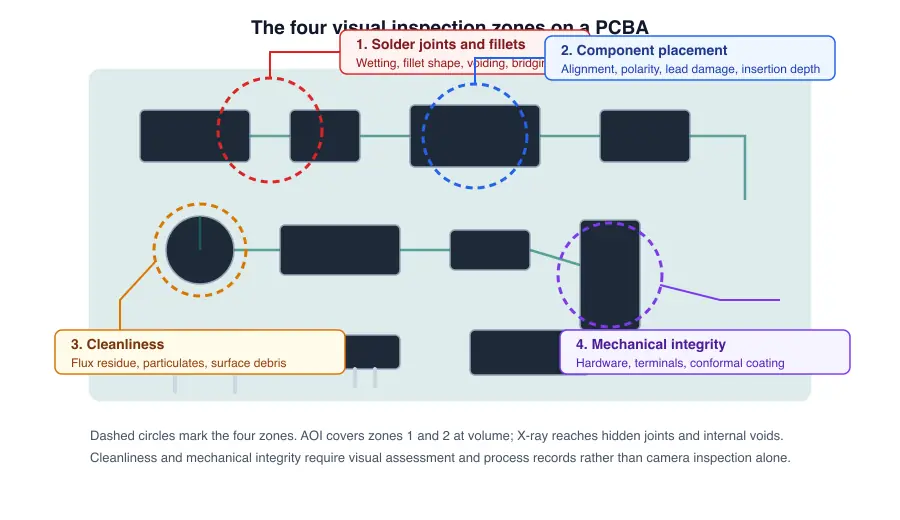
Visual rejections concentrate in four areas. Understanding them tells you where your process is most likely to drift.
Solder joints and fillets
The joint is the inspection. Inspectors assess wetting angle, fillet height and shape, lead coverage, and pad fill, and they look for conditions that weaken the joint: insufficient wetting, dewetting where solder has pulled back from the surface, bridging where solder has joined two lands that should stay separate, and voiding inside the joint.
Fillet geometry matters because it is what carries mechanical load. A joint that is electrically connected today can still be mechanically inadequate under thermal cycling or vibration, which is why the criteria address shape and not just continuity.
Component placement and orientation
Placement criteria cover alignment against the pads, polarity orientation on polarised parts, damage to leads, and insertion depth on through-hole parts. An offset component is judged on whether the electrical and mechanical connection survives, not on how it looks, though Class 3 narrows what counts as acceptable offset considerably.
Cleanliness and contamination
Cleanliness criteria cover flux residue, foreign particles, and surface debris. The failure mechanism is what makes this a Class 3 concern: contamination creates leakage paths between conductors, drives corrosion, and interferes with coating adhesion and sensor performance. A board that is electrically functional when built can fail in service because of what was left on it.
Mechanical integrity and conformal coating
This area covers hardware installation, wire and terminal securing, service loops, and conformal coating coverage, thickness, and voiding. Coating is inspected for coverage of the intended areas and for bubbles and voids that leave a component unprotected.
Two inspection technologies supplement visual assessment rather than replacing it. Automated optical inspection (AOI) handles repeatable visual criteria at volume, but it only sees what a camera can see. X-ray inspection reaches the hidden joints and internal voids under area-array packages that no visual standard can assess. For Class 3 work with BGA content, expect both.
Aligning an AOI programme with these acceptance criteria is a separate exercise, and the criteria above are what that programme should be built around.
IPC-A-610 Certification and Training: CIS, CIT and CSE
IPC delivers training through three certification levels, and which one you need depends on whether you inspect assemblies, train other people, or govern the standard across an organisation.
| Level | Full name | Who it is for |
|---|---|---|
| CIS | Certified IPC Specialist | Operators, inspectors, and assembly staff who apply the standard |
| CIT | Certified IPC Trainer | People qualified to teach and certify others in-house |
| CSE | Certified Standards Expert, with Senior CSE (SCSE) as its upper tier | Quality and engineering leadership needing deep standards expertise |
The CIS course is the standard path and typically runs three days, with three to four days the common published range, combining lecture, the official materials, hands-on practical work, and the exam. Certification is valid for two years, after which recertification is required to cover the current revision.
Indicative course costs run roughly $700 to $1,200 for CIS and $1,800 to $2,500 for CIT, with recertification generally costing around 60% to 70% of the original course fee. Treat these as indicative only. IPC does not publish a global price list; fees are set by each licensed training centre and vary by region, provider, and which standards the course covers. Contact a licensed centre for a current figure.
What to ask a supplier about their certification
Certification is not a single yes-or-no fact about a company, so ask three specific questions:
- Which revision are you certified to? Certified to H is not the same as certified to J.
- Which class or classes do you inspect to? Some providers are certified across both Class 2 and Class 3.
- Are your trainers currently CIT certified? This determines whether they can train and recertify your own inspection team in-house.
Certification is valid for two years, so ask for evidence of current validity rather than accepting a certificate date at face value.
How to Specify IPC-A-610 on an RFQ or Purchase Order
State three things on every document that governs the build: the revision, the class, and any customer-specific criteria. Everything else follows from those three.
A specification clause that covers the ground:
“Assemblies shall be manufactured and inspected to IPC-A-610J Class [2 or 3]. Acceptance criteria not specified in IPC-A-610J shall be as agreed between user and supplier, as recorded in the workmanship supplement attached to this order.”
The three-item checklist behind that clause:
- Cite revision and class on every RFQ, purchase order, and assembly drawing. Not on one of the three. Ambiguity at the quoting stage becomes a dispute at inspection, when the boards are already built and the negotiating position is gone.
- Confirm the supplier’s certification is current for that revision and class. Ask which revision they are certified to, and whether their in-house trainers hold current CIT status.
- Attach any customer-specific workmanship supplement. If your programme tightens or relaxes specific criteria, document it and reference it on every order. Undocumented supplements are the single most common source of acceptance disputes.
The AABUS clause in the wording above is doing real work. It tells the supplier that unspecified criteria are agreed rather than assumed, and it points at the document where those agreements live.
Common Misconceptions About IPC-A-610
Five assumptions about this standard are common, and all five cost money.
“The IPC class determines the electrical design or the component quality.” It does not. The class defines workmanship acceptance. The same board design can be built to different classes depending on end use, and component selection is a separate decision entirely.
“Class 3 is always better.” It is not. Applying Class 3 to a product whose operating environment does not demand it buys inspection cost, not durability. The reliability benefit is real only where the environment actually stresses the assembly.
“You can build part of a board to Class 2 and part to Class 3.” You cannot. A PCBA is manufactured to a single base class. Individual criteria can be tightened or relaxed only by AABUS agreement, which is a different thing from building to two classes at once.
“IPC-A-610 is a certification.” It is not. It is a specification you cite on a purchase order. Inspectors and trainers hold certification against it; the standard itself is a document, not a credential.
“IPC-A-610 covers bare boards.” It does not. Bare board acceptability is covered by IPC-A-600, and rigid board qualification by IPC-6012. Quoting IPC-A-610 against a bare board is citing the wrong document.
“We evaluate solder joints against the ‘Target’ condition.” The “Target” condition no longer exists. It was officially removed in Revision H (2020) to eliminate ambiguity. Solder joints and features are simply Acceptable, a Process Indicator, or a Defect. Demanding “Target” conditions invites unnecessary disputes and relies on an obsolete framework.
“Our drawing specifies IPC-A-610 Rev I.” Revision I was deliberately skipped by IPC to prevent confusion with the numeral 1. A purchase order or drawing specifying “Rev I” creates legal and technical ambiguity. If you intend to mandate the current standard, specify IPC-A-610J.
Frequently Asked Questions
What is IPC 610 used for?
IPC-A-610 is used to set the visual and workmanship acceptance criteria for finished electronic assemblies, so that an OEM and its contract manufacturer agree objectively on what is acceptable before an assembly ships. It is applied by inspectors and quality engineers at defined acceptance points, and it is cited on purchase orders to remove ambiguity from the acceptance decision.
How long does it take to get IPC 610 certification?
The standard Certified IPC Specialist (CIS) course takes about three days, with three to four days the common range, covering lecture, the official materials, hands-on practical work, and the exam. Certification is then valid for two years before recertification is required.
How do I get IPC-A-610 certification?
You train through an IPC-licensed training centre or a Certified IPC Trainer (CIT). There is no self-study or self-certification route, because the certification requires a supervised practical assessment. Contact a licensed centre for current availability, pricing, and which revision the course covers.
What is the difference between J-STD-001 and IPC-A-610?
J-STD-001 governs the soldering process and the materials used to build the assembly, while IPC-A-610 governs whether the finished result is acceptable. In practice, J-STD-001 certified operators build to the process requirements and IPC-A-610 certified inspectors apply the acceptance criteria to the result.
Does IPC-A-610 cover bare PCBs?
No. IPC-A-610 applies to assembled boards only. Bare printed board acceptability is covered by IPC-A-600, and rigid board qualification and performance by IPC-6012.
Can you build part of a board to Class 2 and part to Class 3?
No. A PCBA is manufactured to a single base class. Individual acceptance criteria can be tightened or relaxed by AABUS agreement between user and supplier, but that is an adjustment to specific criteria, not building one board to two classes.
Is IPC-A-610 a certification?
No. IPC-A-610 is a specification, specifically a set of acceptance criteria that you cite on a purchase order. Certification exists for people: CIS for inspectors and operators, CIT for trainers, and CSE or SCSE for standards experts.
Why is there no IPC-A-610 Revision I?
The letter “I” was skipped in the standard’s revision sequence to prevent typographical confusion with the number “1”. The standard progressed directly from Revision H (September 2020) to Revision J (March/April 2024).
Does IPC-A-610 still use the “Target” condition?
No. The “Target” condition was eliminated in Revision H (2020) and is not part of Revision J. Assemblies are evaluated under only three conditions: Acceptable, Process Indicator, and Defect.
Where to Start
Confirm two facts about your own programme: which class the end use actually requires, and which revision your supplier is certified to. Then check whether your purchase orders cite the revision and the class together. If they say “IPC-A-610” without either, that is the gap to close first, and it costs nothing to fix.
For a deeper look at the criteria that separate Class 2 from Class 3, the section above on Class 2 versus Class 3 covers the specific conditions that tighten. If your question is about the soldering process rather than the finished result, the comparison with J-STD-001 covers the other half.
Sources
- IPC / Global Electronics Association, IPC-A-610J: Acceptability of Electronic Assemblies, published March 2024, superseding Revision H (2020). The authoritative document, available from IPC and its licensed resellers including the ANSI Webstore.
- IPC / Global Electronics Association, Meet Your Standards, for the scope statements of IPC-A-610J, J-STD-001, IPC-A-600, IPC-A-620, IPC-7711/7721 and IPC-6012, and for the relationship between A-610 and J-STD-001.
- IPC / Global Electronics Association, IPC certifications, for the CIS, CIT, MIT, CSE and SCSE programme definitions and audiences.
- IPC, IPC-A-610 Acceptability of Electronics Assemblies Endorsement Program, covering CIS, CIT and CSE certification.
- IPC, Professional Training and Certification Policies and Procedures, v6.1, for the two-year certification term and the 90-day extension provision.
- IPC, PCBA Checklist, for the official Class 1, Class 2 and Class 3 definitions.
- Blackfox Training Institute, an IPC-licensed training centre, for CIS course duration and the framing of who needs the credential.
- ESCATEC, IPC-A-610 Class 1, 2 and 3: which standard fits your PCBA, for the Revision J change summary and class comparison.
- DYC Electronic, IPC-A-610 Class 3 vs Class 2, for one of the published Class 3 cost premium ranges.
- PCB Insider, IPC Certification Cost Guide, for indicative CIS and CIT course pricing and recertification terms.