JLCPCB and PCBWay are two of the most commonly ordered PCB manufacturers considered by engineers, hardware startups, hobbyists, and procurement teams. Both support PCB fabrication and PCB assembly, but the better choice depends on board complexity, BOM sourcing, assembly requirements, lead time risk, documentation needs, and total landed cost.
Key Takeaways
- Choose JLCPCB first for simple, cost-sensitive prototypes and standard SMT builds that fit its automated
orderingflow.- Choose PCBWay first for complex PCB requirements, sourcing flexibility, customer-supplied parts, or projects needing more manual review.
- For US buyers, compare total landed cost: PCB, assembly, components, shipping, customs, communication time, and rework risk.
- Quote both suppliers with the same Gerber, BOM, lead time, assembly scope, and shipping method before making a procurement decision.
This comparison does not treat either supplier as universally better. Instead, it explains where each supplier tends to fit best so PCB engineers and buyers can choose based on project requirements, not just the lowest headline PCB price.
For related planning, see your internal PCB DFM checklist, PCB assembly guide, and PCB quote checklist.
How We Compared JLCPCB and PCBWay
This article compares JLCPCB and PCBWay by the criteria that usually matter in engineering and procurement decisions: fabrication capability, PCBA workflow, BOM sourcing, lead time, shipping to the US, DFM support, documentation, and project fit.
Because prices, lead times, component stock, coupons, and shipping rates change frequently, this article does not claim that one supplier is always cheaper. Treat all pricing conclusions as directional. For a real project, use the same Gerber files, BOM, quantity, lead time, surface finish, assembly scope, and shipping method on both platforms on the same day.
Official capability pages should be checked before ordering: JLCPCB PCB capabilities, JLCPCB assembly capabilities, PCBWay capabilities, and PCBWay PCB assembly. Forum and Reddit comments can reveal buyer pain points, but they should be treated as anecdotal, not authoritative evidence.
Quick Verdict: JLCPCB vs PCBWay
Choose JLCPCB if your project is a standard PCB prototype, simple SMT assembly, or cost-sensitive build that fits well inside a self-service ordering flow. It is especially convenient when your design uses EasyEDA and components available through the JLCPCB/LCSC ecosystem.
Choose PCBWay if your project has more complex fabrication requirements, a less standard BOM, customer-supplied components, special materials, rigid-flex needs, or assembly details that benefit from more manual review and communication.
| Decision factor | JLCPCB | PCBWay |
|---|---|---|
| Best fit | Standard prototypes and simple SMT | Custom PCBs and flexible sourcing |
| Ordering style | Fast self-service flow | More RFQ/custom review options |
| BOM sourcing | Strong when parts fit its ecosystem | Better fit for non-standard sourcing needs |
| Fabrication complexity | Strong for standard specs | Stronger fit for special requirements |
| Buyer priority | Low cost and speed | Flexibility and communication |
| Main caution | BOM/library limitations can slow assembly | Simple boards may quote higher |
For production, regulated products, or high-reliability applications, neither choice should be made from a website quote alone. The supplier should be qualified against your quality, documentation, traceability, inspection, and corrective-action requirements.
JLCPCB and PCBWay at a Glance
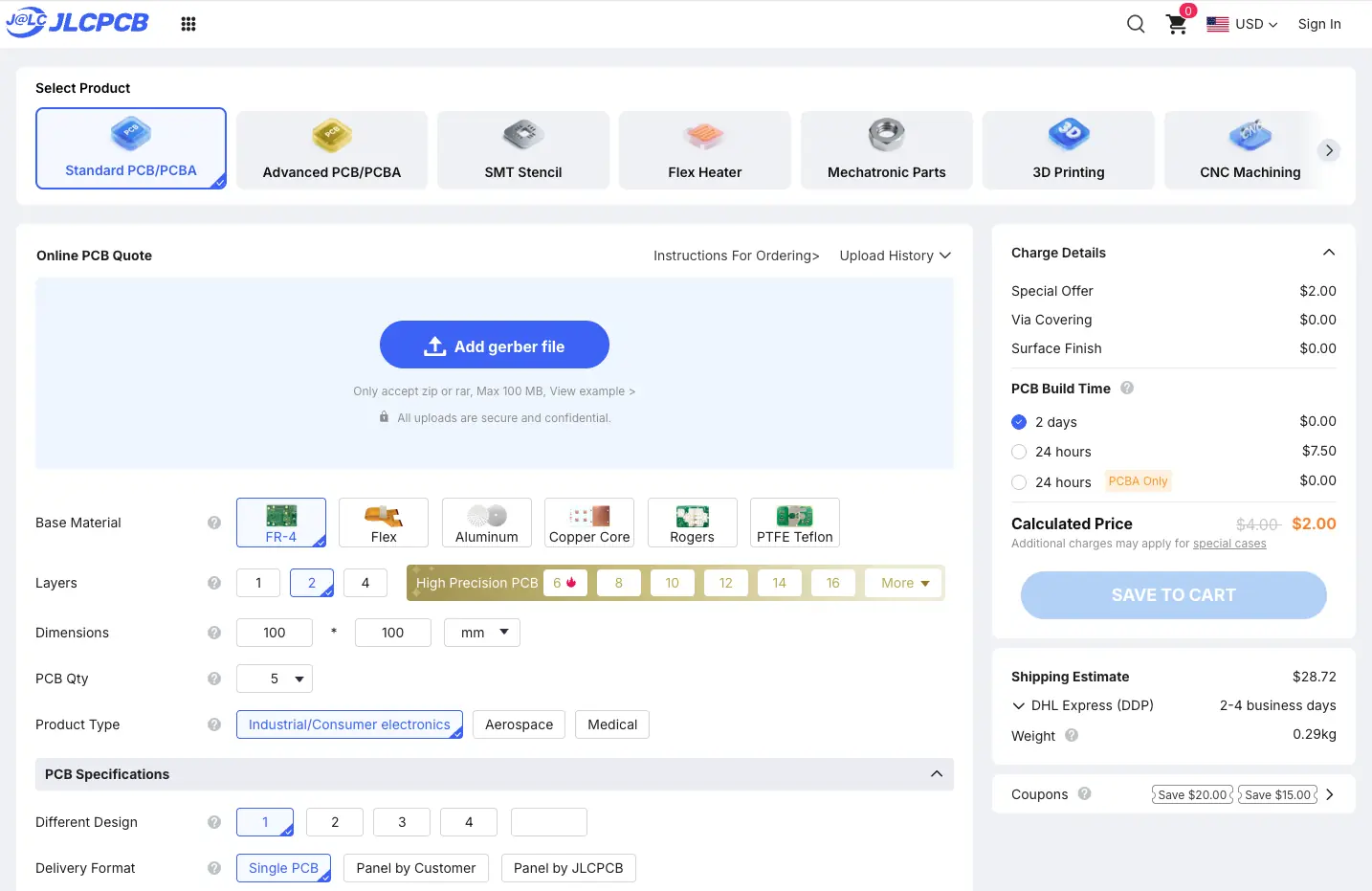
JLCPCB is best known for low-cost PCB prototypes, fast online quoting, PCB assembly, and integration with EasyEDA and LCSC. For engineers who design inside that ecosystem, the workflow can be efficient: design the board, select available parts, upload files, quote, and order with minimal back-and-forth.
This makes JLCPCB a good fit for standard FR-4 boards, simple 2-layer or 4-layer designs, cost-sensitive samples, EasyEDA users, and SMT assemblies using parts available through its parts flow.
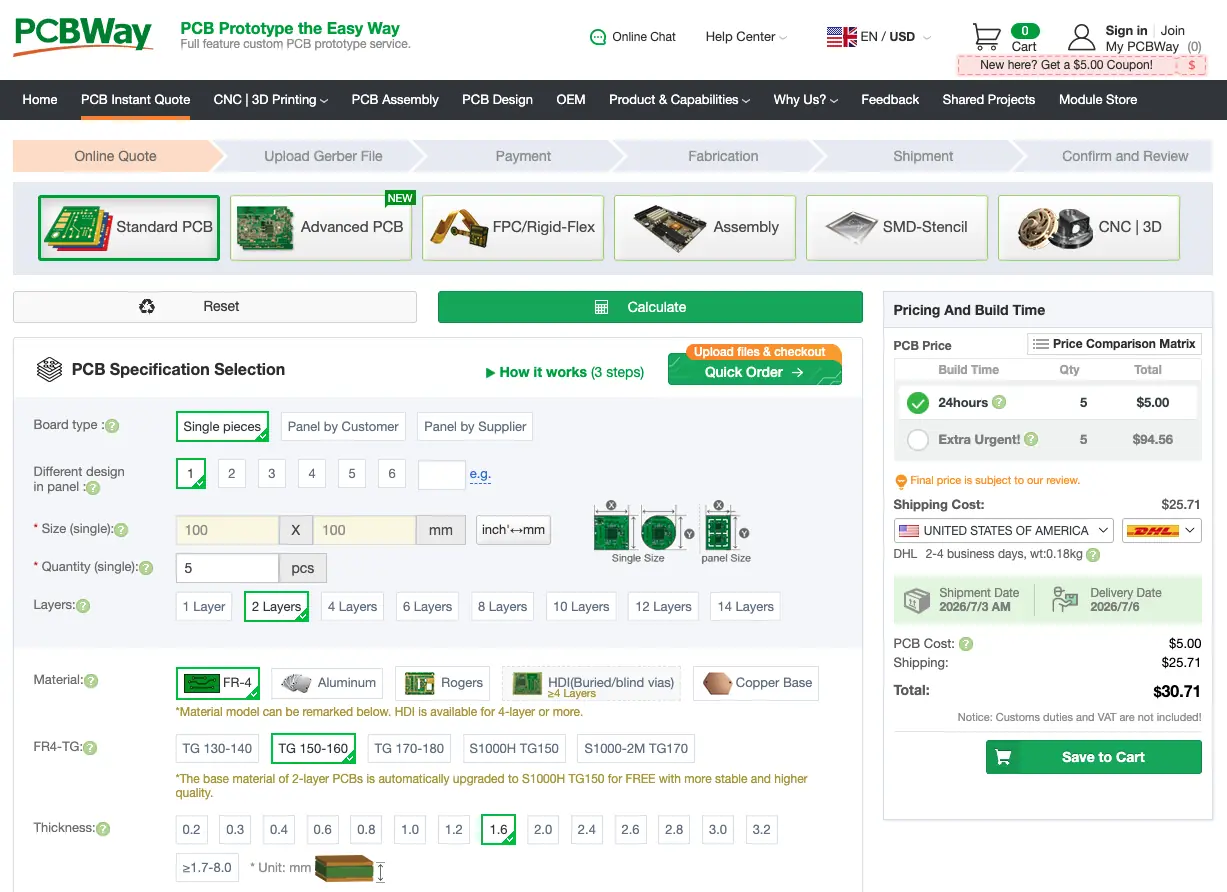
PCBWay is also widely used for PCB prototyping and assembly, but it positions itself as a broader manufacturing platform. It is commonly considered for customized PCB work, assembly with more sourcing flexibility, and projects that need more communication around requirements.
This makes PCBWay a good fit for rigid-flex, HDI, metal core, special material projects, customer-supplied or non-catalog components, and buyers who want more manual review before production.
The practical difference is operating model. JLCPCB tends to be strongest when the project is easy to standardize. PCBWay tends to be stronger when the project needs more interpretation, sourcing flexibility, or customization.
Pricing: Which Is Cheaper?
JLCPCB is often the cheaper starting point for simple prototype PCBs, especially standard FR-4 boards with basic specifications. PCBWay may quote higher for simple boards, but the gap can shrink or reverse when the project includes special fabrication requirements, component sourcing, assembly complexity, or discounts.
The mistake is comparing only the first PCB fabrication number shown in the quote tool. For engineering and procurement decisions, compare total landed cost:
- Bare PCB fabrication
- SMT or through-hole assembly
- Component sourcing
- Setup fees
- Stencil cost, if needed
- Engineering review or special handling
- Shipping to the US
- Customs or import costs
- Rework or delay risk
For a very simple board, JLCPCB may win because the order fits the automated workflow. For a more complex board, PCBWay may become more competitive because the quote can reflect project-specific handling.
Use this same-spec quote checklist before deciding:
| Quote input | Why it matters |
|---|---|
| Same Gerber files | Prevents layout/spec differences from skewing price |
| Same board quantity | Quantity breaks can change the winner |
| Same layer count and thickness | Core fabrication drivers |
| Same copper weight | Affects price and manufacturability |
| Same surface finish | HASL, ENIG, OSP, hard gold, and other finishes price differently |
| Same lead time | Rush builds distort comparison |
| Same assembly scope | SMT only vs mixed SMT/THT changes cost |
| Same BOM and alternates | Component availability can dominate PCBA cost |
| Same shipping method | Total landed cost depends heavily on freight |
The best rule is simple: quote both suppliers with the same files, same BOM, same assumptions, and same shipping method. Then compare delivered cost and schedule risk, not just the first price shown online.
PCB Fabrication Capabilities
JLCPCB and PCBWay both handle standard PCB fabrication, but their strongest use cases are different. JLCPCB is usually a strong fit for standardized prototype boards. PCBWay is often worth a closer look when the design has special materials, advanced construction, or custom fabrication requirements.
| Fabrication need | Better starting point | Why |
|---|---|---|
| Standard 2-layer FR-4 prototype | JLCPCB or quote both | Price and speed usually drive the decision |
| Standard 4-layer prototype | JLCPCB or quote both | Both are viable if specs are common |
| Cost-sensitive small boards | JLCPCB | Strong fit for automated standard orders |
| Larger boards | Quote both | Board area can shift the price gap |
| HDI PCB | PCBWay or quote both carefully | Requires capability and DFM confirmation |
| Rigid-flex PCB | PCBWay | More custom review is usually needed |
| Metal core PCB | PCBWay or quote both | Thermal stackup and material details matter |
| High-frequency PCB | PCBWay or quote both | Material and impedance requirements need review |
| Fast standard repeat order | JLCPCB | Streamlined ordering can reduce friction |
For engineers, the main task is to match the board to the supplier’s standard capability before ordering. If the PCB has tight impedance control, dense vias, unusual copper weight, non-standard stackup, or strict cosmetic requirements, ask for a DFM review or written confirmation.
PCB Assembly and BOM Sourcing
PCB assembly is where the JLCPCB vs PCBWay comparison becomes more project-specific. A supplier that looks cheaper for bare boards may not be cheaper once component sourcing, substitutions, assembly rules, placement fees, customer-supplied parts, and review time are included.
JLCPCB is often a strong fit when the BOM is designed around parts available in its ordering ecosystem. If the components are in stock, acceptable for the assembly tier, and compatible with the process rules, the workflow can be efficient.
The risk appears when the BOM was not designed around that parts flow. If several components are unavailable, restricted, or require substitutions, the engineer may need to redesign around stocked alternatives, split the build, hand-solder missing parts, or move to a different sourcing path.
PCBWay is often more attractive when BOM flexibility matters. It may be a better fit when the project uses customer-supplied components, distributor-sourced parts, special components, or approved manufacturer part numbers that cannot be replaced casually.
A practical PCBA comparison should ask:
| Question | Why it matters |
|---|---|
| Are all BOM items available? | Missing parts delay assembly or force redesign |
| Are exact MPNs required? | Some products cannot accept generic substitutions |
| Are approved alternates listed? | Reduces sourcing delay |
| Are any parts customer-supplied? | Adds kitting, shipping, and receiving steps |
| Is the assembly SMT-only or mixed SMT/THT? | Mixed assembly changes cost and handling |
| Are BGAs or fine-pitch ICs used? | Inspection and process capability matter |
| Is documentation required? | Procurement may need traceability or CoC records |
For simple assemblies, JLCPCB may be faster and cheaper. For BOMs that need sourcing flexibility or more human review, PCBWay may reduce order friction.
Lead Time and Shipping to the US
Lead time is not just the number of production days shown in an online quote. For US buyers, the real schedule includes fabrication, assembly, BOM sourcing, engineering review, payment confirmation, carrier pickup, international shipping, customs handling, and any delay caused by DFM or part availability issues.
JLCPCB can be very fast when the project fits its standard process. PCBWay may involve more human review, especially for custom PCB specs or assembly requirements. That review can add time before production starts, but it can also catch issues earlier.
Shipping to the US adds another variable. DHL, FedEx, UPS, and other express options may be fast, but the final delivery date still depends on pickup timing, customs clearance, declared value, import handling, and regional delivery.
When comparing suppliers, ask for both the estimated ship date and estimated delivered date. Engineering teams care when boards arrive on the bench, not when production theoretically finishes.
Quality, DFM, and Support
Quality in a JLCPCB vs PCBWay comparison should not be reduced to “which one is better?” Both suppliers can produce good boards when the design fits their process and the files are clean. The useful question is which supplier better matches the project’s quality risk, review needs, and communication style.
JLCPCB’s quality advantage is consistency in standardized work. Automated quoting, automated checks, and high-volume production can work well for common PCB types and simple assemblies.
PCBWay’s advantage is often communication and custom handling. For projects that need manual review, sourcing discussion, special fabrication options, or customer-supplied materials, that extra communication can be valuable.
DFM review is especially important for controlled impedance boards, HDI or microvia designs, rigid-flex boards, metal core or high-frequency materials, fine-pitch BGA assembly, mixed SMT and through-hole assembly, and boards requiring special inspection or documentation.
For US procurement teams, support quality is also about documentation. If the project needs inspection records, material information, certificates, traceability, or formal corrective action after a defect, confirm that before ordering.
Decision Matrix: Which Should You Choose?
Use JLCPCB as the first quote when the board is standard, cost-sensitive, and easy to fit into an automated flow. Use PCBWay as the first quote when the build needs customization, sourcing flexibility, or more communication before production.
| Project scenario | Better starting point | Why |
|---|---|---|
| Cheapest simple PCB prototype | JLCPCB | Strong fit for standardized, cost-sensitive boards |
| EasyEDA-based design | JLCPCB | Workflow aligns with EasyEDA and the parts ecosystem |
| Simple SMT assembly with available parts | JLCPCB | Efficient when the BOM fits the available library |
| Larger board with basic specs | Quote both | Board area can shift the price comparison |
| Complex BOM sourcing | PCBWay | More flexible sourcing and communication may help |
| Customer-supplied components | PCBWay | Custom handling and kitting instructions matter |
| Rigid-flex, HDI, or special materials | PCBWay | Advanced builds usually need closer review |
| Mixed SMT and through-hole assembly | PCBWay or quote both | Manual handling and assembly details can change fit |
| Fast standard repeat order | JLCPCB | Automated reorder flow can reduce friction |
| US procurement requiring documentation | Quote both carefully | Documentation needs should drive qualification |
| Regulated or high-reliability product | Qualify supplier formally | Website quote alone is not enough |
When Not to Use Either Supplier Without Qualification
For hobby boards, engineering prototypes, and many commercial samples, online PCB manufacturers can be a practical choice. For regulated, safety-critical, aerospace, medical, automotive, or high-reliability products, supplier qualification should come before ordering.
In those cases, confirm quality system scope, inspection records, traceability, material documentation, corrective-action process, and whether the supplier can support the required IPC class or customer-specific standard. A low online quote is not a substitute for supplier approval.
FAQ
Is JLCPCB cheaper than PCBWay?
JLCPCB is often cheaper for simple standard PCB prototypes, especially boards with common specifications. PCBWay may be more expensive for basic boards, but the comparison changes with board size, assembly, component sourcing, special materials, shipping, and discounts.
Is PCBWay better quality than JLCPCB?
Not universally. Both suppliers can produce good boards when the design fits their process. JLCPCB is strong for standardized builds, while PCBWay may be better suited for projects that need custom review, broader options, or more communication.
Which is better for PCB assembly?
JLCPCB is often a strong choice when the BOM fits its available component ecosystem and the assembly is straightforward. PCBWay may be better when the BOM needs more sourcing flexibility, customer-supplied components, mixed assembly, or detailed communication before production.
Which is better for US customers?
For US customers, the best choice depends on total landed cost and schedule risk. Include PCB cost, assembly, components, shipping, customs handling, and communication time. JLCPCB may be faster and cheaper for standard orders. PCBWay may be safer for custom builds that need review.
Should engineers quote both JLCPCB and PCBWay?
Yes, especially for new projects. Use the same Gerbers, BOM, quantity, lead time, surface finish, assembly scope, and shipping method. A fair same-spec quote is the only reliable way to know which supplier is better for a specific build.
Should I use JLCPCB or PCBWay for production?
For production, quote both only after the design, BOM, test requirements, inspection needs, and documentation requirements are stable. Then qualify the supplier against your quality and supply-chain requirements. The best prototype supplier is not automatically the best production supplier.
Conclusion
JLCPCB and PCBWay are both useful PCB manufacturing options, but they serve different project profiles. JLCPCB is usually the stronger first stop for simple, cost-sensitive prototypes and standard SMT builds. PCBWay is often stronger when the project requires customization, sourcing flexibility, or more human review.
For PCB engineers, the right choice depends on whether the design fits the supplier’s process. For procurement, the right choice depends on delivered cost, schedule confidence, documentation, and supplier risk. Quote both when the project matters, and choose the supplier that best fits the build, not the one that wins a generic comparison.
Need a second opinion before ordering? Send the Gerber, BOM, assembly drawing, and target quantity for a quote-readiness and DFM review before committing to a supplier.
